Introduction
Microsites contain a concise profile of the key elements of your company.
Multilingual Microsites present the same information online in 35 languages*.
This allows you to present your company, products, and services online in 35 languages, reaching 166 countries and 95% of global GDP — without agencies, plugins, or complex SEO projects.
* We are always trying to improve the service. If you would like us to add another language, please make your suggestion and we will see what we can do. Any new languages will be included at no extra charge for existing subscribers.
Multilingual Microsites provide a simple, practical way to achieve international visibility.
- A simple, low-cost alternative to foreign-language SEO.
- Very quick and easy to set up, edit and publish.
- An absolute breeze to maintain — no programming skills required.
- An incredibly low, fixed, all-inclusive annual cost.
- A fully managed service.
- A discovery-first approach to international visibility.
Multilingual Microsites are ideal for:
- Not just for Large Enterprises, but also for companies of any size that are already exporting or would like to export.
- B2B suppliers and manufacturers.
- SMEs without in-house SEO teams.
- Companies seeking international visibility before heavy investment.
They are not designed for:
- Single-market SEO domination strategies or businesses seeking top rankings in one specific country.
- Companies running advanced, market-specific backlink or localisation campaigns.
- Large enterprises with dedicated in-house SEO teams or bespoke multi-market SEO programmes.
Important note: Multilingual Microsites are not a replacement for advanced foreign-language SEO, which requires tailored strategies for each language, market, and cultural context.
They do, however, provide a scalable, low-risk baseline solution that solves the international discovery problem for the majority of exporters who will never commission a full SEO project.
Conclusion
If you are considering entering international markets, or increasing your presence there, subscribing to a Multilingual Microsite should be one of your first actions.
*Multilingual Microsites are not just for exporters. They can also be used to:
- Improve supply chains by identifying new international suppliers
- Enable domestic business service providers to offer services to foreign clients
The Benefits
Why Exporters Struggle with Foreign-Language SEO
- SEO often sounds expensive.
- SEO often sounds complex.
- SEO usually requires long-term commitment.
- Exporters frequently need visibility now, not in six or twelve months.
A Multilingual Microsite resolves these issues by providing immediate international visibility.
Presented in 35 languages, it gives you reach across 166 countries representing 95% of global GDP.
The Key Benefits of a Multilingual Microsite include:
Advertise Your Products and Services Globally:
- Most people search online in their own language, not in English.
- Your Multilingual Microsite includes relevant keywords and phrases in 35 languages, helping overseas buyers and partners find you using the terms they naturally search for.
Improved International Search Visibility:
- Because there is often less competition for non-English search terms, your products and services are more likely to appear prominently in search results in those languages and markets.
Improved User Experience for International Visitors:
- International visitors can read about your company, products, and services in their own language, increasing understanding, trust, and engagement.
Additional SEO Benefit for Your Main Website:
- Your Multilingual Microsite generates a large number of language-specific pages, creating multiple backlinks that can also strengthen the visibility of your main website.
Flexibility and Ease of Management:
- You can update your Multilingual Microsite whenever needed. No programming skills or technical knowledge are required.
Competitive Advantage in International Markets:
- Presenting your business in multiple languages gives you a clear advantage over competitors who operate only in one or two languages.
Hosting with a Dedicated Subdomain:
- Your annual subscription includes hosting on ExpoWorld.cloud, with your own dedicated subdomain.
Additional Benefits:
- Insight into international demand: You gain visibility into where enquiries and traffic originate, helping you identify countries where your products or services are attracting interest. This reduces guesswork and lowers the risk of misdirected overseas marketing.
- Very low, fixed cost: The list price equates to only a few US cents per language per week, making international visibility accessible to exporters of any size.
Comparative Analysis
Below we compare the Multilingual Microsite service with alternative approaches commonly used to achieve international online visibility:
- SEO Agencies.
- Translation plugins.
- Wix Multilingual
- Google Ads.
N.B. In addition to the differences outlined below, all of these alternatives typically cost significantly more than the fixed annual subscription for a Multilingual Microsite.
How does a Multilingual Microsite differ from hiring an SEO agency?
SEO agencies typically work with:
- specific countries or languages.
- bespoke, market-by-market strategies.
- long implementation timelines.
- variable and often high costs.
Multilingual Microsites provide:
- immediate visibility in 35 languages.
- predictable, fixed subscription pricing.
- flexibility to update and test content quickly.
Without:
- any technical setup.
- any ongoing SEO management.
Many exporters use a Multilingual Microsite as a first step, and later invest in targeted SEO for priority markets once demand is clearer.
Is a Multilingual Microsite a replacement for advanced foreign-language SEO?
No. Multilingual Microsites are not a replacement for advanced foreign-language SEO projects.
They are a simple, fixed-price alternative for exporters who require broad international visibility without committing to complex, market-by-market SEO strategies.
For many exporters, this approach solves the majority of the visibility challenge before any dedicated SEO project is required.
How do Multilingual Microsites compare to translation plugins (e.g. Weglot)?
Translation plugins translate existing websites, but typically still require:
- technical setup and integration.
- ongoing content management.
- SEO configuration.
- regular updates and maintenance.
Multilingual Microsites are fully managed, search-optimised landing pages, designed specifically for international discovery, rather than for translating an existing website.
How does Wix Multilingual compare to Multilingual Microsites?
Wix Multilingual
Wix provides a built-in multilingual solution (Wix Multilingual) that allows a Wix website to present content in multiple languages through its editor or dashboard.
- You can translate your site manually or automatically into many languages using the translation tools in the Wix editor. support.wix.com
- Upon installation of the multilingual feature, Wix provides an initial quota of translation credits (e.g., 3,000 free words) for machine-assisted translation.
- Additional translation work may require purchasing more credits or manually editing content. Wix does not publish a clear, fixed price for translation credits or the multilingual add-on itself.
- Multilingual SEO settings and URL structures (subdomains, subdirectories, or parameters) can be customised, but the setup and ongoing maintenance are done within Wix’s platform.
- Wix multilingual functionality is tied to your site build and hosting plan (e.g., Light, Business, Enterprise), which have separate costs starting from basic premium plans.
Multilingual Microsites by contrast provide:
- Global language coverage presented on a dedicated hosted subdomain outside of your main website.
- A fully managed discovery-first solution tailored for exporters, with 35 languages included in a single annual subscription price.
- A fixed-price model with no hidden fees or variable costs for languages or clicks.
- A focus on international discoverability without requiring platform-specific website changes.
Key points of difference
- Pricing transparency: Multilingual Microsites have a fixed, all-inclusive subscription, whereas Wix’s multilingual tools are included with the site builder but may involve additional translation credits, and multilingual capability is tied to your Wix plan.
- SEO and discoverability: ExpoWorld’s service is designed specifically to support search discovery across multiple language markets; Wix’s multilingual solution is part of a general site builder that includes translation and SEO options within its editor.
- Independence from website platform: Multilingual Microsites sit independently of your primary website technology, avoiding the need to manage multilingual versions within a specific CMS or builder.
For exporters seeking rapid, low-risk international discoverability, Multilingual Microsites offer a simpler and more predictable alternative to extending a full website across multiple languages.
How do Multilingual Microsites compare to Google Ads?
Although both services aim to drive traffic to your website, they work in very different ways. They should be seen as complementary, not competing, approaches.
The key differences can be summarised as follows:
- Service Scope
- Multilingual Microsites provide a very wide reach, covering a large number of keywords and phrases across 35 languages.
- Google Ads focuses on a limited number of selected keywords or phrases and forms part of Google’s wider advertising tools used to create, manage, and analyse paid campaigns.
- Cost Structure
- With Google Ads, you pay on a cost-per-click basis up to a defined budget limit. Once that limit is reached, the campaign stops.
- With a Multilingual Microsite, you pay a fixed annual subscription. There is no limit to the number of visitors or clicks to your website.
- Keywords & Phrases
- With Google Ads, campaigns are typically built around individual keywords or phrases in a single language (or multiple separate campaigns for different languages).
- A Multilingual Microsite, by contrast, contains extensive keyword and phrase coverage, replicated across all 35 supported languages.
If you are considering Google Ads to promote your products or services internationally, it often makes sense to start with a Multilingual Microsite.
Once you have identified which keywords, phrases, and languages generate the most interest, Google Ads can then be used to further promote those specific terms through targeted advertising campaigns.
Conclusions
The Multilingual Microsite service does not compete directly with SEO agencies, translation plugins, website builders with multilingual features (such as Wix), or paid advertising platforms like Google Ads. Instead, it is designed to complement them.
Multilingual Microsites provide exporters with immediate, broad international visibility through a fixed-price, discovery-first solution that operates independently of their main website and underlying technology. This allows companies to test international demand across multiple languages and markets at low risk and low cost.
Based on the results generated by a Multilingual Microsite, exporters can then make informed, evidence-based decisions about whether and where further investment in more complex, market-specific solutions — such as advanced SEO, localisation, platform-based multilingual websites, or paid advertising — is commercially justified.
Our own comparisons are reinforced by independent analysis from platforms such as ChatGPT, Claude, Copilot, DuckDuckGo, Perplexity, Brave and Google AI Mode. Read their unfiltered views in Independent AI Assessments.
Multilingual Microsite Example
Multilingual Microsites are currently provided in 35 languages.
These languages cover 166 countries and 31 dependencies*, representing a combined population of over 7 billion people and approximately USD 124 trillion (95%) of global GDP.
For a full list of countries and territories covered, including population and GDP figures, please see : Multilingual Microsites - Languages Covered & Global Reach.pdf . See also ExpoWorld’s own Multilingual Microsites.
* We are always trying to improve the service. If you would like us to add another language, please send us your suggestion and we will see what we can do. Any new languages will be included at no extra charge for existing subscribers.
Main Components of a Multilingual Microsite:
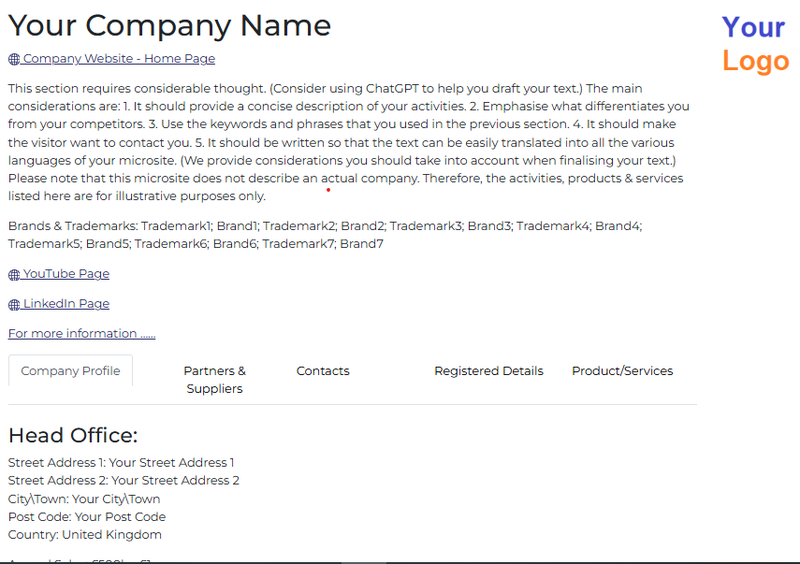
Below, you can see the main elements of a Multilingual Microsite:
- Company Profile.
- Partners & Suppliers.
- Contacts.
- Registered Company Details.
- Products and/or Services.
This example shows an example of an English language home page.
This example shows the same microsite with access to 35 different languages; generated from the original English content.
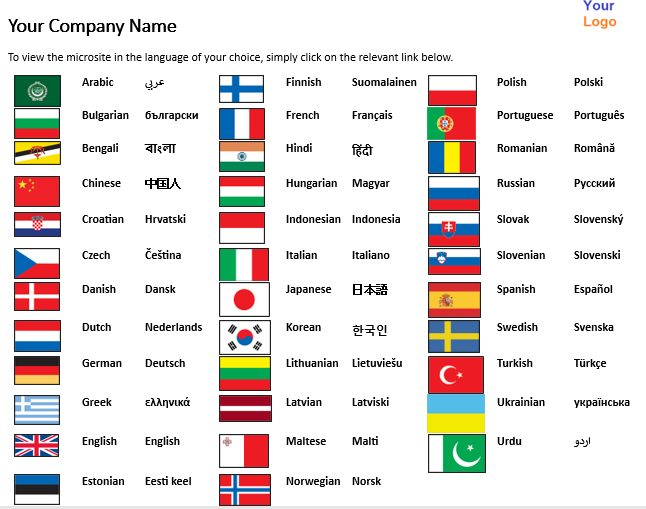
These examples are provided to illustrate what a Multilingual Microsite looks like and to give you ideas on how you might structure your own content.
N.B. When viewing a foreign-language version of a Multilingual Microsite, your browser may automatically translate the page into your own language, depending on your browser settings.
Getting The Most Out of Your Multilingual Microsite
Exporters typically use Multilingual Microsites in the following ways:
- As a first step into international markets.
- As an international visibility layer alongside existing websites.
- As a market-testing tool before investing in targeted SEO.
Multilingual Microsites can also be used in the following ways:
As Virtual Stands:
- Your Multilingual Microsite can be used independently, or as a Virtual Stand within a Virtual Trade Mission.
- In a Virtual Trade Mission context, additional functionality such as live video, audio, and chat may be enabled to support real-time interaction.
To Support Specific Marketing Campaigns:
- Use the relevant language version of your Multilingual Microsite to support marketing campaigns in specific countries, and include the corresponding link in emails and collateral sent to those markets.
- When launching a new product or service, you can link directly to the relevant product- or service-specific page instead of the generic home page.
(If you would like us to add another language, please send us your suggestion and we will see what we can do. Any new languages will be included at no extra charge for existing subscribers.)
As a Multilingual Feature of Your Home Website:
- In the top menu of your Home Website, add “Other Languages” (like we have) linked to your Multilingual Microsite. This allows visitors to choose their language to read about your company, products, and services.