A Practical Framework for Measuring International Visibility
Your Multilingual Microsite is designed to act as a long-term discovery engine for international markets. Its purpose is not to generate campaign-style traffic spikes, but to build slow, compounding visibility across many languages and countries.
You do not need any technical expertise to configure and manage your Multilingual Microsite. Optimisation and indexing setup are handled automatically as part of the Multilingual Microsite publication process.
If any of the terms in this section are unfamiliar, we provide step-by-step guidance in:
- Configuration Guide & Check List - Configuring Your Multilingual Microsite
- Using AI Platforms for Export Content Analysis and Support (e.g. ChatGPT). - Supporting your content and online presence
- Guide to Online Indexing, Rankings & Traffic Analysis
Optimisation and indexing setup are handled automatically as part of the Microsite publication process.
The 5 Core Goals for your Multilingual Microsite
As a “magnet” and “channel” for international searches, your Multilingual Microsite must achieve five things:
- Be Indexed by Online Search Engines: Its first goal. If your Multilingual Microsite is not indexed, then online searches will not find it.
- Appear in Search Results (Rankings): Your keywords and phrases should help your pages appear when users search in their own language.
- Generate Search Impressions (how often your pages appear in search results - sometimes referred to as “SERPs”): Your pages should appear regularly on search results pages, indicating active demand for what you offer.
- Attract Visits to the Multilingual Microsite: Users should be interested enough to click through from the search result and explore your multilingual pages.
- Generate Contact Actions: Visitors should click through to your Home Site from your Multilingual Microsite, send emails, or call you after being convinced by the Multilingual Microsite.
Use of Tracking Tools - and Why They Matter
Analytics help reduce uncertainty when selecting international markets. They help you understand:
- what search engines can see and index,
- whether people are searching for what you offer (impressions),
- whether they are interested enough to visit (click-throughs and visits), and
- whether that interest turns into contact actions.
Low or zero results are still valuable signals. They often indicate either:
- limited demand
- or the need to refine positioning
Where possible, compare Multilingual Microsite signals (visibility) with your Home Website performance (conversion).
The 5 Goals In Summary
These five goals represent a progression from technical visibility to real commercial interest.

However, before going into the detail of each of these five goals and how you can measure them, we have set out what you should expect from your Multilingual Microsite in terms of searchability and traffic; especially in your first 6–8 weeks.
Important Note
The timelines outlined in this section are indicative and will vary depending on product type, keyword competitiveness and levels of international demand.
Companies in niche markets may see earlier signals, while others may experience more gradual discovery as search engines evaluate and index new content.
Results are also influenced by the clarity and structure of your Multilingual Microsite content, particularly how products and services are described and the keywords used.
Additional visibility may be supported by sharing links to the Multilingual Microsite through existing digital channels.
The Next Tab, What to Expect, outlines how Multilingual Microsites typically develop over time and what early visibility signals may look like in practice.
What to Expect
Multilingual Microsites are designed for gradual, compounding discoverability, rather than short-term marketing bursts or campaign-driven traffic. Typically:
- Initial indexing may begin within a few days.
- Early visibility signals often appear within several weeks.
- Meaningful discovery patterns usually develop over a period of months.
For most companies, the early weeks should be viewed as an observation and signal-gathering period, rather than a time for immediate commercial outcomes.
Why Early Signals Can Appear
Because Multilingual Microsites publish structured content simultaneously across many languages, search engines may initially test the pages in a wide range of search queries. This means early indexing and occasional exploratory visits can appear relatively quickly, even before meaningful traffic develops.
Over time, search engines observe user behaviour and gradually prioritise languages, countries and search terms where genuine demand is detected.
Phases
You should consider the development of your Multilingual Microsite in structured phases. Each phase reflects a different stage in how search engines discover, test, and prioritise your content, and how early international signals begin to emerge.
The development of a Multilingual Microsite follows a structured progression across four phases:
Phase 1 — Stabilise & Observe (Weeks 0–2)
Phase 2 — Signal Capture (Weeks 2–6)
Phase 3 — Pattern Recognition (Weeks 6–12+)
Phase 4 — Long-Term Optimisation (Ongoing)

This progression moves from initial technical visibility to the identification of meaningful international demand signals.
Typical Timeline for a New Multilingual Microsite:
Phase 1 — Stabilise & Observe (Weeks 0–2)
Focus: Technical indexing and initial discoverability.
Days 1–7
- Pages begin to appear in search engine indexes.
- Some language versions may start appearing in search results.
- First rankings may appear (typically for low-competition terms).
- Very little or no traffic is expected.
Days 7–14
- First exploratory clicks may occur.
- Early visits may total only a small number of users.
At this stage, activity is primarily driven by search engine indexing and early testing of your content.
Phase 2 — Signal Capture (Weeks 2–6)
Focus: Early visibility signals and initial international reach.
- Most language versions become indexed.
- Occasional visits from different countries may begin to appear.
- Early exploratory enquiries may occur.
Success Indicator:
Your microsite begins appearing in search results across multiple languages or countries, sometimes accompanied by occasional exploratory visits.
Phase 3 — Pattern Recognition (Weeks 6–12+)
Focus: Identifying emerging demand patterns.
Over time, analytics may begin to reveal consistent signals. At this stage, it is important to focus on patterns rather than individual visits, as search engines may initially test pages across multiple languages and regions.
Key Questions To Consider:
- Are specific countries appearing repeatedly?
- Are certain languages dominant?
- Are there repeat visitors?
- Are enquiries product-specific?
Interpretation:
- If yes → consider targeted follow-up actions.
- If no → allow the microsite to continue running. International discoverability often develops gradually.
Phase 4 — Long-Term Optimisation (Ongoing)
Focus: Reinforcing visibility where demand exists.
Over time, search engines naturally prioritise languages and pages where they observe:
- Search demand
- User engagement
- Repeated visits
Other languages may appear less frequently or disappear from visible results. This is normal and does not indicate failure. Your microsite remains discoverable, but search engines prioritise languages where user demand is strongest.
Positioning Note
These phases reflect a transition from:
technical visibility → signal generation → informed decision-making.
The Next Tab, What Success Looks Like, explains how to interpret early results and set appropriate expectations for international discoverability.
What Success Looks Like (Realistically)
Because multilingual microsites are discoverable across many languages simultaneously, even a small number of visits can provide valuable signals about potential international demand.
Success should not be measured by:
- Immediate sales.
- High rankings across all languages.
Success is reflected in:
- International discoverability.
- Credible inbound interest.
- Geographic signals indicating potential markets.
- Reduced uncertainty when selecting target countries.
Next Steps
In the following tabs you will see:
- How to monitor indexing, rankings, impressions and visits.
- How to track visitors and outbound clicks.
- How to interpret early signals when considering your next international steps.
The Next Tab, Indexing, explains how your Microsite is discovered and indexed by search engines, forming the foundation for international visibility.
Search Engine Indexing
How Your Multilingual Microsite Becomes Discoverable
To be found in search results, your Multilingual Microsite must first be indexed by search engines. As explained in the previous section you should allow at least 1 week for this and up to 4 weeks to have a more complete picture. You should also note that different search engines have different index time cycles.
Implementing Best Practices to ensure Search Engine Optimisation (SEO) is mainly a technical exercise. These Best Practices have already been implemented within your Multilingual Microsite. This means your Microsite is technically ready for indexing from day one. Here we simply:
- Set out what we have done.
- Explain how you can check the extent of the indexing of your Multilingual Microsite.
Best Practices
The Best Practices that we have automatically implemented are as follows:
- Generation of your optimised sitemap.xml
- Registration and verification of your Multilingual Microsite with Google Search Console.
- Generation of your optimised robots.txt.*
- Generation of relevant technical references in each webpage.
*You never need to touch the Google Search Console unless you want to inspect reports. However, these can be interesting. See: Guide to Online Indexing, Rankings & Traffic Analysis.
Why Best Practices Matter
- Search engines use sitemaps as a reliable list of URLs to discover and re-crawl (often faster than relying on navigation alone).
- A robots.txt file helps search engines crawl your site efficiently and avoids wasting crawl time on irrelevant paths.
- hreflang, canonical tags, and language-specific metadata help search engines understand that your pages are language equivalents (not duplicates), improving indexing coverage and consistency
Best Practices - PageSpeed Insights
You can test your Microsite using Google’s free tool PageSpeed Insights. Simply enter the address of your Multilingual Microsite - and, for comparison, that of your Home Website.

This tool provides scores across four areas:
- Performance
- Accessibility
- Best Practices
- SEO
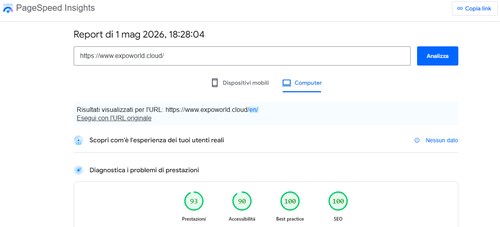
Well-configured Multilingual Microsites typically achieve strong scores across these categories, often in the 90+ range. Where improvements can be made, PageSpeed Insights highlights these and provides guidance on how to address them.
Checking The Indexing of Your Multilingual Microsite
Quick Check (Site Command)
One quick, but imperfect way is to type the following into your browser
site:webaddress
This should list the pages that Google has indexed e.g.
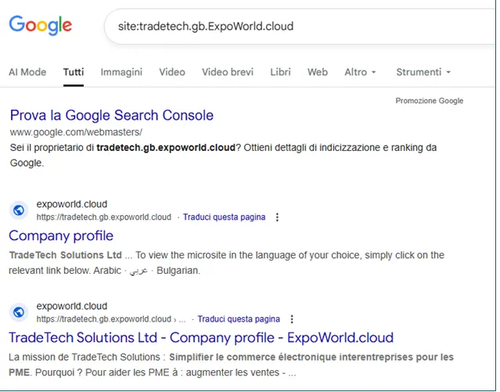
N.B. Although it provides a very quick check, do not consider this to be a Complete Index. The site command is sample based and publishes only an estimate of what Google has indexed. Google itself says it is:
- Incomplete
- Sample-based
- Filtered by perceived quality
Google Search Console (GSC)
Once you have registered your Google Account Email* in the Administration Page, you can access Google Search Console. This will show a series of reports relating to the indexing status of your Multilingual Microsite.
*If you do not yet have a free Google Account, you can create one here.
Once your Multilingual Microsite has been indexed, the next check to carry out is to see how your key words and phrases are performing (Search Engine Ranking).
The Next Tab, Ranking, explains how your Microsite positions in search results and how keyword selection influences visibility.
Search Engine Ranking - Where Your Microsite Appears
This tab focuses only on where you appear in search results — not how often users see you. That is covered in the next section on impressions. (We suggest you wait at least one week before carrying out this test to give the search engines time to index your Multilingual Microsite.)
Checking Options
The options you have for checking the Search Engine Rankings of the Key Words and Phrases of your Multilingual Microsite are:
Manual: Check your keywords and phrases in the different languages using at least the two most widely used international search engines:
Commercial Services: Some businesses choose to use commercial SEO tools to automate ranking checks across many languages and search engines. These tools are not required for using Multilingual Microsites, but may be useful for companies that want deeper SEO reporting.
If your keywords and phrases are not generating visibility, consider refining or expanding them.
With your keywords and phrases ranking in online searches, the next statistic to look at is how many searches are made where your Multilingual Microsite is listed (Search Engine Impressions).
The Next Tab: Impressions, explains how often your Microsite appears in search results and how to interpret early visibility signals.
Search Engine Impressions - Measuring Visibility
Search Engine Impressions tell you how often online searches for your products or services result in your Multilingual Microsite being listed (“Impressions”).
This is your first real signal of demand.
Google Search Console (Free Service)
In our opinion, this is the best free tool to see how your Multilingual Microsite performs in search results.
- Performance Report: Log in and navigate to the Performance section to see a list of queries (keywords) bringing traffic to your site.
- Metrics: It shows the total number of clicks, impressions, and the average position for each keyword.
Commercial Services
There are dedicated, commercial SEO Tools (for both Rankings and Search Engine Impressions) you can use. They provide comprehensive reports on the total number of keywords, search volume, traffic, and ranking positions.
For more details explaining how you can assess the level of impressions your Multilingual Microsite is achieving, see the Guide to Online Indexing, Rankings & Traffic Analysis.
Once impressions begin to appear, the next question is whether, and how many, users are interested enough to click-through to your Multilingual Microsite, which we measure through visitor tracking.
The Next Tab: Visitor Tracking, explains how to analyse visitor behaviour and identify early international demand signals.
Multilingual Microsites - Visitor Tracking
From Visibility to Engagement.
Key Metrics
These tell you how many Users were interested enough to visit your Multilingual Microsite. They also provide you with their key profile characteristics.
Options
To track visitors to your Multilingual Microsite, you should:
- Subscribe to at least one tracking service.
- Insert the code that you will be given into the tab “Traffic Tracking & Indexing” in the Administration Page.
Free tracking services:
*Any analytics platform that provides page views, outbound clicks, and country/language breakdowns can work — GA4 is simply the most common free option.
Visitor Tracking Benefits
Integrating your Multilingual Microsite (and, we would suggest, your Home Site) with a tracking service allows you to see:
- Visits by country, region, city.
- Visits by language and device.
- How they found your microsite (search, links, direct).
- Behaviour on each language page.
- How long visitors stay and what they click.
(In the Guide to Online Indexing, Rankings & Traffic Analysis, we explain how you can access this information using Google’s GA4 tracking service.)
This helps you:
- Identify promising export markets.
- Validate early demand signals before committing resources.
- See which languages generate interest.
- Decide where to invest next.
Visitor tracking shows whether people are interested. The next step is to see whether that interest leads them to your Home Site.
The Next Tab, Home Site Visitors, explains how to see whether that interest leads them to your Home Site.
Home Website - Visitor Tracking
Key Metrics
These tell you how many Users were interested enough to visit your Home Site from your Multilingual Microsite. They also provide you with their key profile characteristics.
(Of course, you may be contacted by email or phone, which will not be captured here. Or, a visitor has taken note of your main web address and visits this directly on another occasion.)
Tracking Options
There are two main methods for tracking clicks from your Multilingual Microsite to your Home Site:
1. Automatic outbound click tracking. Use GA4’s Visitor Tracking service linked to your Multilingual Microsite. (See previous tab.) GA4 automatically tracks clicks to external websites. This shows:
- How many visitors leave the microsite to your main site.
- Which language pages send the most traffic.
2. UTM Tags (More precise). Add UTM tags to links from your Multilingual Microsite. Then use the Visitor Tracking service linked to your Home Site. (see Multilingual Microsites - Configuration Guide & Check List).
UTM parameters are short tracking tags added to the end of a web link in your Multilingual Microsite. They allow analytics tools (such as GA4) to identify:
- Where a visitor came from.
- Which page or campaign sent them.
- What type of link they clicked.
For a more detailed explanation of UTMs see (the Guide to Online Indexing, Rankings & Traffic Analysis).
We have now outlined the five goals your Multilingual Microsite should achieve and how you can measure relevant statistics and information for each stage.
The Next Tab, Next Steps, outlines how to monitor and interpret each of the phases — from search visibility to real commercial interest — and what actions you can take if results are weaker than expected.
Next Steps - Key Principle
You do not need complex analytics or specialist expertise. In most cases, a simple monthly review is sufficient:
- Countries report.
- Languages report.
- Pages report.
- Acquisition report.
From these you can:
- Identify your top 3–5 countries by interest.
- See which languages perform best.
That is usually enough to guide your international decisions.
What to do if results are not as good as you hoped.
1. Keyword Ranking: If your keywords and phrases are not getting the rankings you would like, try another approach and set of keywords and phrases.
2. Impressions: High rankings with low impressions usually indicate you are ranking well for "low-volume" or niche keywords, or your target audience is very small. To increase visibility, expand your keyword strategy to include broader, related terms.
3. Click-throughs to your Multilingual Microsite: Review your “title and meta description” and what Google actually presents under links to your Multilingual Microsite. Does this express what you want potential clients to see? Does it grab their attention? Impressions/CTR can often be improved by refining title + meta description, not just the meta description.
For all three of the above, make sure that your: Keywords & Phrases, Meta Description and Company Profile mirror and reinforce each other. You can also use AI tools to propose alternative versions.
4. Click-throughs to your Home Site: Review your Multilingual Microsite Profile, can you make it more convincing to persuade visitors to contact you? Are you recording contacts made indirectly (emails and phone calls?). Are you asking new, potential clients how they found you?
We would also recommend that you use AI Platforms (such as ChatGPT) to not only help you generate content for your Multilingual Microsite but also help position your company and its products & Services. (See Using AI to Generate Structured Export Content and Using AI to Generate Structured Export Content.)
Please remember, your Multilingual Microsite is a tool for you to use, its ultimate success will depend upon you publishing compelling content (Company Profile, Product & Service Profiles, Keywords & Phrases, meta description etc.) Monitoring rankings and traffic will help you fine tune that content and so help unlock your international potential.
Multilingual Microsites do not work in isolation
Your Multilingual Microsite is just one element, albeit a significant one, in your online international marketing activity. Do not neglect your presence on other online resources; especially YouTube Videos, LinkedIn. Also, don’t forget that you can benefit from your Multilingual Microsite in other ways (see: Multilingual Microsites/Optimal Use).
The Next Tab, Data & Privacy, explains how data is managed across the platform and how control of analytics and visitor information is maintained
Privacy & Data Ownership
ExpoWorld can help you connect your Multilingual Microsite to tools such as Google Search Console (for search visibility and indexing) and Google Analytics 4 (for visitor behaviour and traffic analysis).
These tools are operated by third parties. Any data collected is subject to their own terms of service and privacy policies.
Google Analytics 4 (GA4)
- TradeTech Solutions / ExpoWorld does not access or store your GA4 visitor data.
- You control who has access to your GA4 account.
Google Search Console (GSC)
- TradeTech Solutions / ExpoWorld may have limited technical access to search visibility data via GSC. This access is used to:
- diagnose indexing or visibility issues.
- support you if something is not working correctly.
- improve the Multilingual Microsite platform overall.
- TradeTech Solutions / ExpoWorld may use combined, anonymised data from many Multilingual Microsites to:
- improve the service.
- monitor indexing health.
- produce high-level market or geographic insights for partners (e.g. chambers of commerce).
Any aggregated reporting is produced only at macro level and only where it meets our anonymisation and data-ethics rules.
These insights:
- Never identify individual companies.
- Never reveal commercial performance.
- Never include personal visitor data.
What Comes Next
You can now use these insights to monitor performance, identify emerging international demand, and make informed decisions about your export strategy.
Regular, structured reviews of your Multilingual Microsite and website analytics will help you prioritise markets and refine your international positioning over time.