Multilingual Microsites – Overview
Increase your international visibility and reach new markets with a Multilingual Microsite — learn how it works below or subscribe here.
The Challenge
Most SMEs have a website, usually in one or at most a few languages.
However, buyers in other countries search in their own language. If your website is not in that language, it is unlikely to appear in those searches — even if you offer exactly what those buyers need.
This means potential international sales opportunities may be missed.
ExpoWorld’s Multilingual Microsites are designed specifically to address this problem.
The Solution
We provide a Multilingual Microsite service that presents your company, products and services in 35 languages.
You remain in full control of your content and can update it at any time. Any updates you make are translated and published automatically, so your updated information can be online within minutes.
The service is designed to be simple and low-cost, making international visibility accessible without the need for multiple websites or ongoing marketing spend.
What Influences Visibility
The visibility of a Multilingual Microsite is influenced by several practical factors:
- Competitiveness of keywords and phrases
Common or highly competitive terms may take longer to gain visibility, particularly in larger markets. - Specificity of content
More precise and structured descriptions of products and services improve relevance for international search queries. - Clarity of product and service descriptions
Clear, well-defined content helps search engines match your Microsite with appropriate buyer intent. - Level of international demand
Visibility will naturally be higher where there is existing search demand for your products or services in specific markets.
The effectiveness of your Multilingual Microsite therefore depends on the quality and specificity of the source content provided.
For practical guidance, see: Multilingual Export Content Checklist (3 pages).
What to Expect
Following publication, your Multilingual Microsite will begin to be discovered and indexed by search engines across multiple languages.
This typically occurs progressively over weeks and months, rather than immediately:
- Initial discovery (first 1–2 weeks) – search engines begin identifying and indexing selected language versions
- Early visibility (weeks 2–4) – some pages begin to appear in search results across different markets
- Signal generation (from week 3 onwards) – initial visits and impressions provide early indications of international interest
Each Multilingual Microsite builds its visibility over time, supported by the ExpoWorld platform infrastructure and, where applicable, institutional or partner linking.
It is important to understand that:
- Visibility will vary depending on language, market, and product type
- Early activity should be interpreted as directional insight, not final performance
- Results depend on content quality, search demand, and ongoing usage
Active promotion by the company (for example, linking from your website, LinkedIn profile, and communications) can further support visibility and accelerate early engagement.
For practical steps, see: ✔ Multilingual Microsite Promotion Action Plan (3 pages).
The objective is not to dominate rankings in individual markets, but to ensure international discoverability across multiple languages, enabling potential buyers to find your company and generating early engagement signals.
For practical guidance on indexing, rankings, and traffic analysis, see: Guide to Online Indexing, Rankings & Traffic Analysis (49 pages)
What This Section Covers
The following tabs explain how Multilingual Microsites work, what benefits they provide, and how they can support your international sales and trade activities.
They also show how this approach differs from traditional websites and digital marketing methods, outline the global reach and pricing of the service, and include independent assessments of its effectiveness.
Further Guidance
The items in the left-hand menu explain how to set up and configure your Multilingual Microsite and provide practical guidance on preparing your content. They help you present your products clearly and get the best results from your Multilingual Microsite.
For practical guidance and common questions on using your Multilingual Microsite effectively, please refer to the Multilingual Microsite FAQs.
The Next Tab explains what a Multilingual Microsite is and how it is structured. It outlines the key components of a Microsite and shows how your company, products and services are presented across multiple languages.
What Are Multilingual Microsites?
A Microsite contains a concise profile presenting the key elements of your company.
Multilingual Microsites present the same information in multiple languages.
ExpoWorld’s Multilingual Microsite service allows you to present your company, products, and services in 35 languages, without agencies, plugins, or complex SEO projects.
ExpoWorld’s Multilingual Microsite service allows you to present your company, products, and services in 35 languages, without agencies, plugins, or complex SEO projects.
Each Multilingual Microsite operates as an independent subdomain, enabling companies to retain full control of their content, analytics, and tracking.
Language availability note
Language should never be a barrier to trade. If you would like us to add another language, please make your suggestion and we will see what we can do. Any new languages will be included at no extra charge for existing subscribers.
Multilingual Microsites* provide a simple, practical way to achieve international visibility.
- A simple, low-cost alternative to foreign-language SEO
- Very quick and easy to set up, edit and publish
- An absolute breeze to maintain — no programming skills required
- An incredibly low, fixed, all-inclusive annual cost
- A fully managed service
- A discovery-first approach to international visibility
Multilingual Microsites are ideal for:
- Companies of any size — not only large enterprises - that are already exporting or would like to export.
- B2B suppliers and manufacturers.
- SMEs without in-house SEO teams.
- Companies seeking international visibility before heavy investment.
They are not designed for:
- Single-market SEO domination strategies or businesses seeking top rankings in one specific country.
- Companies running advanced, market-specific backlink or localisation campaigns.
- Large enterprises with dedicated in-house SEO teams or bespoke multi-market SEO programmes.
Important note: Multilingual Microsites are not a replacement for advanced foreign-language SEO, which requires tailored strategies for each language, market, and cultural context.
They do, however, provide a scalable, low-risk baseline solution that solves the international discovery problem for the majority of exporters who will never commission a full SEO project.
Conclusion
If you are considering entering international markets, or strengthening your presence there, a Multilingual Microsite can be one of the first practical steps to improve your international visibility.
*Multilingual Microsites are not just for exporters. They can also be used to:
- Improve supply chains by identifying new international suppliers
- Enable domestic business service providers to offer services to foreign clients
The Next Tab presents a Multilingual Microsite Example, illustrating how structured multilingual content is deployed in practice and how it supports international visibility and discoverability.
Multilingual Microsite Example
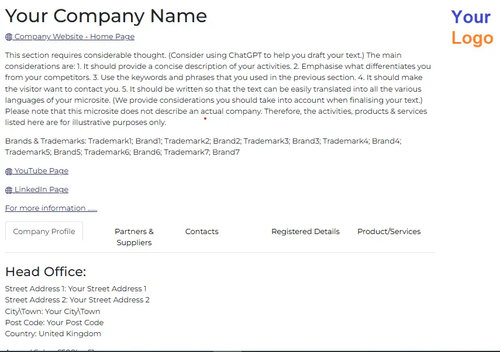
A typical Multilingual Microsite contains the following elements:
- Company profile
- Partners and suppliers
- Contact information
- Registered company details
- Products and/or services
The illustration below shows an example of an English language home page.
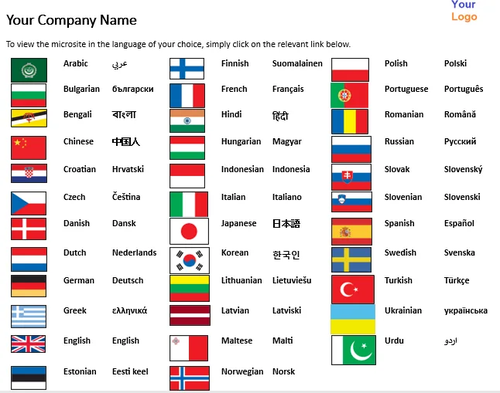
Access to 35 Languages
The next illustration shows the same microsite with access to 35 language versions, automatically generated from the original English content.
You can also view ExpoWorld’s own Multilingual Microsites as practical examples of how the system works.
These examples are provided to illustrate how a Multilingual Microsite appears to international visitors and to help exporters understand how they might structure their own content.
Note
When viewing a foreign-language version of a Multilingual Microsite, your browser may automatically translate the page into your own language, depending on your browser settings.
The Next Tab outlines the benefits of Multilingual Microsites, highlighting how structured multilingual presence enhances international visibility, supports market access and strengthens export engagement.
Benefits
Multilingual Microsites are designed to address the practical challenges companies face when trying to reach international markets online.
This tab outlines the limitations of English-only websites and traditional foreign-language SEO.
It also explains how a Multilingual Microsite provides a simple, structured solution for improving international visibility.
Each Multilingual Microsite also provides an independent analytics environment, enabling companies to use tools such as Google Analytics (GA4) and campaign tracking while retaining full control of their data.
Why English-Only Websites Limit International Visibility
Many companies assume that publishing their website in English allows them to reach international markets. However, around 90% of the world’s population does not have English as a first language, and most people begin online searches in their own language.
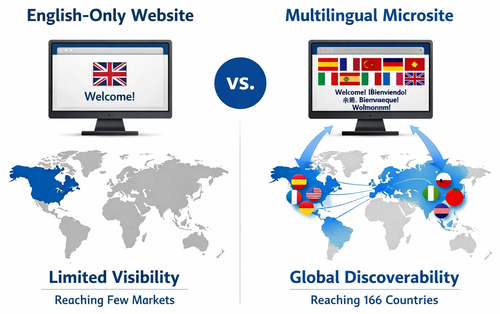
Companies that publish only in English therefore risk missing a significant share of international search activity.
Multilingual Microsites address this challenge by making your company, products, and services discoverable in 35 languages across 166 countries.
Why Exporters Struggle with Foreign-Language SEO
Search engine optimisation (SEO) can often appear:
- Expensive
- Complex
- Dependent on long-term commitment
For many exporters, however, international visibility is needed now, not in six or twelve months.
A Multilingual Microsite addresses these challenges by providing immediate international digital visibility.
Key Benefits:
Advertise Your Products and Services Globally:
Most people search online in their own language, not in English. Your Multilingual Microsite includes relevant keywords and phrases in 35 languages, allowing overseas buyers and partners to find you using the terms they naturally search for.
Improved International Search Visibility:
Competition for search terms is typically lower in non-English languages. As a result, your products and services are more likely to appear prominently in search results across those markets.
Improved User Experience for International Visitors:
Visitors can read about your company, products, and services in their own language, improving understanding, trust, and engagement.
Additional SEO Benefit for Your Main Website:
Your Multilingual Microsite generates a large number of language-specific pages, creating multiple backlinks that can strengthen the search visibility of your main website.
Flexibility and Ease of Management:
Your Microsite can be updated whenever required. No programming skills or technical knowledge are needed.
Competitive Advantage in International Markets:
Presenting your business in multiple languages provides a clear advantage over competitors who communicate in only one or two languages.
Hosting with a Dedicated Subdomain:
Your annual subscription includes hosting on ExpoWorld.cloud, with your own dedicated subdomain.
Insight into international demand:
You gain visibility into where enquiries and traffic originate, helping you identify countries where your products or services are attracting interest. This reduces guesswork and lowers the risk of misdirected overseas marketing.
Very low, fixed cost:
The list price equates to only a few US cents per language per week, making international visibility accessible to exporters of any size.
The Next Tab details the languages covered by Multilingual Microsites and the global reach this provides. It shows how presenting your information in multiple languages enables buyers in different countries to find and understand your business.
Languages Covered and Global Reach
ExpoWorld Multilingual Microsites are currently provided in 35 languages.
These languages provide coverage across 166 countries and 31 dependencies, representing a combined population of over 7 billion people and approximately USD 124 trillion — around 95% of global GDP.
For a full list of countries and territories covered — including population and GDP data — please see: Multilingual Microsites - Languages Covered & Global Reach.
If you would like us to add another language, please send us your suggestion and we will see what we can do. Any new languages will be included at no extra charge for existing subscribers.
The Next Tab provides a comparison with other approaches, examining how Multilingual Microsites differ from traditional export and digital marketing methods in terms of complexity, cost and effectiveness.
Comparison with Other Approaches
Below we compare the Multilingual Microsite service with several alternative approaches commonly used to achieve international online visibility:
- SEO Agencies
- Translation plugins
- Wix Multilingual
- Google Ads
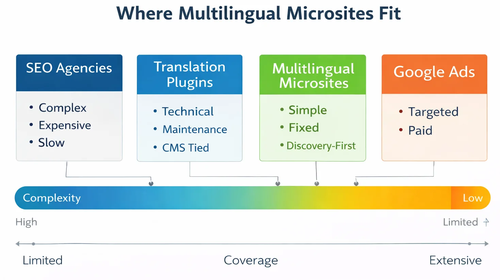
Note: In addition to the differences outlined below, these approaches typically involve significantly higher and less predictable costs than the fixed annual subscription of a Multilingual Microsite.
Multilingual Microsites vs SEO Agencies
SEO agencies typically operate through:
- country-specific or language-specific campaigns
- bespoke market-by-market strategies
- long implementation timelines
- variable and often high costs
Multilingual Microsites provide:
- immediate visibility in 35 languages
- predictable fixed subscription pricing
- the ability to update and test content quickly
Without requiring:
- technical implementation
- ongoing SEO management
Many exporters use a Multilingual Microsite as a first step, and later invest in targeted SEO campaigns for priority markets once demand becomes clearer.
Are Multilingual Microsites a Replacement for Advanced SEO?
No. Multilingual Microsites are not intended to replace advanced foreign-language SEO projects.
Instead, they provide a simple, fixed-price solution for exporters who require broad international visibility without committing to complex market-by-market SEO strategies.
For many exporters, this approach resolves much of the international visibility challenge before any specialised SEO investment becomes necessary.
Multilingual Microsites vs Translation Plugins
(e.g. Weglot or TranslatePress)
Translation plugins translate existing websites but typically still require:
- technical installation and configuration
- ongoing content management
- SEO configuration
- regular updates and maintenance
Multilingual Microsites are different.
They provide fully managed, search-optimised landing pages designed specifically for international discoverability, rather than simply translating an existing website.
Multilingual Microsites vs Wix Multilingual
Wix offers a multilingual feature (Wix Multilingual) that allows websites built on the Wix platform to display content in multiple languages.
Key characteristics include:
- content can be translated manually or automatically within the Wix editor
- an initial allocation of translation credits is provided (e.g. around 3,000 words)
- additional translations may require purchasing more credits or manual editing
- multilingual SEO settings and URL structures can be configured within the Wix platform
- multilingual capability is tied to Wix hosting plans and website subscriptions
Multilingual Microsites differ in several important ways:
They provide:
- global language coverage across 35 languages
- a dedicated hosted subdomain separate from the main website
- a fully managed discovery-first service tailored for exporters
- a fixed annual subscription with no additional language or translation fees
Key Differences:
- Pricing transparency: Multilingual Microsites operate with a fixed annual subscription. Wix multilingual functionality is tied to website plans and may involve additional translation costs.
- SEO focus: ExpoWorld Microsites are designed specifically for international search discoverability, whereas Wix multilingual functionality forms part of a general website-building platform.
- Platform independence: Multilingual Microsites operate independently of your main website technology, avoiding the need to manage multilingual content within a specific CMS or site builder.
For exporters seeking rapid, low-risk international discoverability, Multilingual Microsites offer a simpler and more predictable alternative to building and managing multilingual versions of an entire website.
Multilingual Microsites vs Google Ads
Both services aim to generate traffic but operate in very different ways. They should therefore be viewed as complementary rather than competing approaches.
Service Scope:
Multilingual Microsites:
- provide broad visibility across 35 languages
- include a wide range of keywords and phrases across multiple markets
Google Ads:
- focus on selected keywords or phrases
- operate as part of Google’s paid advertising ecosystem
Cost Structure:
Google Ads:
- operate on a cost-per-click model
- campaigns stop when the allocated budget is exhausted
Multilingual Microsites:
- operate on a fixed annual subscription
- there is no limit on clicks or website visitors
Keyword Coverage:
Google Ads:
- campaigns are typically built around individual keywords in specific languages
Multilingual Microsites:
- include extensive keyword and phrase coverage replicated across 35 languages
For exporters planning international advertising campaigns, it often makes sense to begin with a Multilingual Microsite.
This helps identify which languages, keywords, and markets generate real interest, allowing future advertising campaigns to be targeted more effectively.
Conclusions
Multilingual Microsites do not compete directly with SEO agencies, translation plugins, multilingual website builders such as Wix, or paid advertising platforms like Google Ads.
Instead, they complement these solutions.
They provide exporters with immediate, broad international visibility through a fixed-price, discovery-first service that operates independently of their main website and underlying technology.
This enables companies to test international demand across multiple languages and markets at low cost and low risk.
Based on the results generated, exporters can then make informed decisions about whether and where to invest in more complex solutions such as:
- advanced SEO
- market localisation
- multilingual websites
- targeted advertising campaigns
The Next Tab explains how to get the most out of your Multilingual Microsite, outlining practical steps to maximise international visibility, engagement and export potential.
Getting the Most Out of Your Multilingual Microsite
Exporters typically use Multilingual Microsites in several ways:
- As a first step into international markets. A simple way to establish international visibility before committing to more complex export marketing strategies.
- As an international visibility layer alongside existing websites. A Multilingual Microsite complements your main website by making your products and services discoverable in multiple languages.
- As a market-testing tool. Exporters can identify which countries, languages, and search terms generate interest before investing in targeted SEO campaigns or localised marketing activities.
Additional Ways to Use a Multilingual Microsite
Virtual Stands for Trade Missions. A Multilingual Microsite can also function as a Virtual Stand:
- It may be used independently or integrated into a Virtual Trade Mission.
In a Virtual Trade Mission environment, additional features such as live video, audio, and chat may be enabled to support real-time interaction with visitors.
Supporting International Marketing Campaigns:
Multilingual Microsites can be used to support targeted marketing activities in specific countries.
- Share the relevant language version of your Microsite in emails, newsletters, or promotional material sent to those markets.
- When launching a new product or service, you can link directly to the specific product or service page, rather than directing visitors only to the homepage.
Adding Multilingual Access to Your Home Website
A Multilingual Microsite can also be integrated with your main website.
For example:
- Add an “Other Languages” option in the navigation menu of your Home website (as shown on the ExpoWorld website).
- Link this option to your Multilingual Microsite so visitors can choose their preferred language to learn about your company, products, and services.
The Next Tab outlines the pricing structure for Multilingual Microsites. It explains how the service is provided through a simple, fixed-cost annual subscription designed to remain affordable for SMEs
Pricing Overview
Multilingual Microsites are provided through a simple, fixed-cost annual subscription.
Pricing is structured by country and income level to ensure the service remains affordable for SMEs worldwide. In all cases, the objective is to provide a low-cost, accessible solution for international visibility.
There are no complex pricing tiers or technical add-ons. The service includes setup, translation, hosting and ongoing updates.
Full pricing details are available on the Pricing page.
The Next Tab, presents independent assessments of Multilingual Microsites. It provides an additional perspective on the service and highlights how it has been evaluated in practice.
What Independent AI Reviews Say
ExpoWorld's Multilingual Microsites have been assessed by independent AI platforms and analytical tools.
These reviews consistently highlight the simplicity of the approach, its ability to support international visibility, and its practical value for SMEs seeking to reach new markets.
This independent perspective provides an additional reference point alongside the information presented in this section.
Further details and full review outputs are available in What Independent AI Platforms Say in the left-hand menu.
Next Tab: Conclusion. Having reviewed how Multilingual Microsites work, how they compare with other approaches, and what independent AI platforms say, the final step is to place them in context.
The Conclusion provides a practical perspective on their role — clarifying what they are designed to achieve, how they should be evaluated, and how they fit within a broader international strategy.
Conclusion
A Practical Perspective on Multilingual Microsites
Independent AI platforms consistently position Multilingual Microsites in a similar way:
- Not as a replacement for SEO
- Not as a standalone marketing solution
- But as a practical first step in international market development.
This alignment is important. It confirms that Multilingual Microsites should be understood as part of a broader process — not as a complete solution in isolation.
What They Enable
Multilingual Microsites provide a structured way to:
- Establish international visibility across multiple languages
- Observe real search behaviour in different markets
- Identify where interest is emerging
- Reduce the risk of premature investment in localisation, advertising, or market entry
They make international discovery measurable and comparable.
What They Do Not Replace
They do not remove the need for:
- Targeted SEO in priority markets
- Localised websites or in-market presence
- Ongoing marketing and content development
- Direct engagement with partners, distributors, or clients
Instead, they help determine where these efforts should be focused.
How They Should Be Evaluated
The effectiveness of a Multilingual Microsite should not be judged by:
- Immediate traffic volumes
- Instant enquiries
- High-ranking positions in competitive markets
It should be assessed based on:
- Search visibility across languages
- Early-stage engagement signals
- Geographic patterns of interest
- The quality of insights generated over time
A Practical Role in International Strategy
In practice, Multilingual Microsites function as:
A discovery and testing layer within a wider international growth strategy
They allow companies to move from:
- Assumptions → to observable demand
- Broad ambition → to targeted action
- Uncertainty → to evidence-based decisions
Final Observation
For many organisations, the greatest challenge is not how to expand internationally — but where to focus.
Multilingual Microsites address this directly.
They provide a low-cost, low-risk way to:
- explore multiple markets simultaneously,
- gather real-world signals, and
decide where deeper investment is justified.
In Summary
Multilingual Microsites are not designed to deliver instant results.
They are designed to deliver clarity.
From visibility → to insight → to informed international growth