Digital Business Communities
Connecting Businesses. Unlocking Opportunities. Driving Growth.
Digital Business Communities go beyond traditional business networking. They help organisations build stronger relationships with their SME base while creating new opportunities for business growth and development.
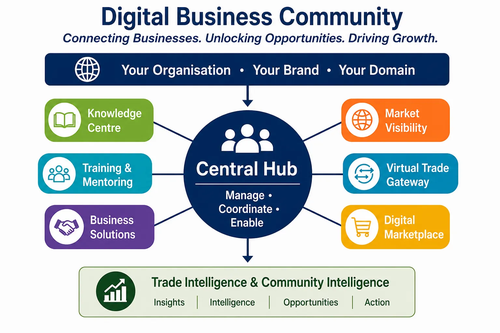
Illustrative Community Structure
Every Digital Business Community is designed during the Discovery Workshop. The underlying operating model remains consistent, while the detailed implementation reflects the Business Community Owner's objectives, operational requirements and local business environment.
This enables organisations to build on existing capabilities and investments rather than replace them, creating a Digital Business Community that reflects local priorities and supports long-term business growth.
Why Digital Business Communities?
Many organisations want to strengthen SME engagement, deliver greater value and create new business opportunities. At the same time, SMEs increasingly need practical support to increase sales, reduce business complexity and improve access to knowledge, business services, market opportunities and finance.
Digital Business Communities help bridge this gap by bringing together the knowledge, services, business networks and opportunities that SMEs need to grow.
They help SMEs to:
- increase sales and business opportunities;
- reduce costs and complexity; and
- improve access to suppliers, service providers, and finance.
At the same time, Business Community Owners can:
- develop new revenue opportunities;
- deliver differentiated value-added services; and
- strengthen customer or member acquisition, engagement, and retention.
The Next Tab, The Structural Challenge, explains why knowledge, business services, business networks and opportunities often exist in isolation, and how Digital Business Communities help bring them together.
The Structural Challenge
Most SMEs do not lack information, services or opportunities.
They suffer from fragmentation.
Knowledge, services, business networks and opportunities exist in isolation.
As a result, SMEs must find, evaluate and coordinate these resources themselves.
This increases cost, complexity and business risk.
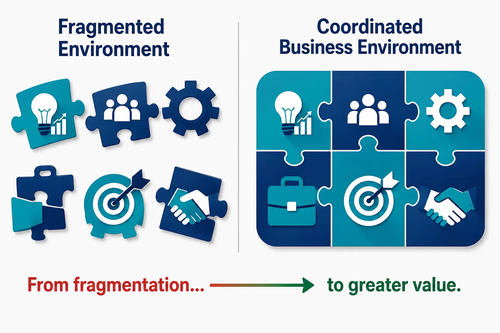
Individual services do deliver value. However, much greater value is created when knowledge, services, business networks and opportunities work together.
Digital Business Communities bring these resources together, making them easier for businesses to discover, access and use.
The result is a more coordinated business environment that is easier to manage, easier to navigate and delivers greater value to both participating organisations and SMEs.
The Next Tab, SME Export Challenges, explores the practical challenges SMEs face when pursuing export opportunities and participating in international trade.
SME Export Challenges
Many SMEs have the products, capability and ambition to export successfully.
However, relatively few build sustainable international business because the export environment is fragmented, complex and difficult to navigate.
Key Constraints Affecting SME Export Growth
Several recurring constraints limit SME participation in international markets:
Limited Access to Essential Resources
Many SMEs operate successfully in domestic markets but lack access to the resources needed to identify and develop international opportunities.
Perceived Complexity and Cost
International trade is often viewed as administratively complex, legally uncertain and financially risky, particularly for companies with limited internal resources.
Market Entry Risk
Traditional export approaches require SMEs to select target markets and commit resources before evidence of demand exists, creating disproportionate commercial risk.
Fragmented Support Structures
Although many export support services exist, they are rarely coordinated. Few organisations provide coordinated support across the full export process, from market discovery to completed transactions
As a result, many export initiatives never progress beyond the planning stage.
The Need for a More Coherent Approach
The challenge is not simply to provide more information or more support services.
SMEs need easier access to the right knowledge, business services, business relationships and market opportunities, delivered through a more coordinated business environment.
Each of these challenges must be addressed if SMEs are to compete successfully in international markets.
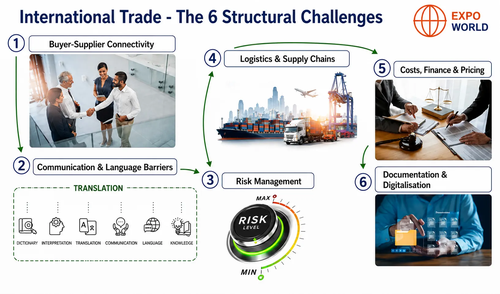
Digital Business Communities help organisations coordinate the knowledge, business services and business support needed to address these challenges, allowing SMEs to focus on developing business rather than managing complexity.
The Protegra Framework provides the structured implementation approach used to design, establish and grow these Digital Business Communities.
The Next Tab, Value, summarises the strategic and operational value that Digital Business Communities can deliver to Business Community Owners.
Value to Business Community Owners
Leverage Your Existing SME Relationships
For many organisations, their SME base is an underutilised asset. Digital Business Communities help unlock its full potential.
From Individual Services to Business Enablement
Digital Business Communities help organisations move beyond individual support services towards a more coordinated approach to business enablement that strengthens engagement, domestic business growth and international trade.
Value for Telecommunications Providers
- Stronger SME engagement
- Value-added business services
- Improved SME retention
- Increased use of digital services
- Scalable business support
Value for Banks
- Trade demand identification
- Client activation
- Trade corridor development
- Increased use of FX, payments and trade finance services
- Enhanced client intelligence
Value for Chambers of Commerce and Trade Associations
- Structured SME international trade programmes
- Improved member visibility
- Data-driven trade programmes
- Stronger partner engagement
- Enhanced member services
The Next Tab, Comparison with Conventional Solutions, compares Digital Business Communities with more conventional approaches to SME support and trade development.
How Digital Business Communities Differ from Conventional Solutions
Organisations supporting SME growth and trade development typically offer a mix of advisory services, training, portals, events and partner networks. While valuable, these are often delivered separately, with limited coordination and limited visibility into how business demand develops over time.
Digital Business Communities address this gap by bringing knowledge, business services, business networks and market intelligence together within a single coordinated business environment.
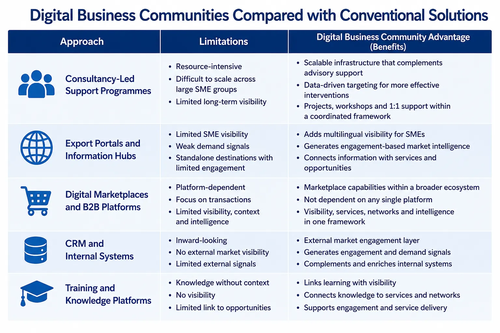
Rather than replacing existing services, Digital Business Communities help organisations unlock the full potential of their existing SME base and the investments they have already made to support it.
Traditional platforms generally offer a predefined structure. In contrast, Digital Business Communities are designed to be technology-independent. The underlying operating model remains consistent, while the supporting technologies are selected to reflect the Business Community Owner's requirements and local operating environment.
The Next Tab, Independent AI Assessment of Protegra, presents independent assessments of the Digital Business Community concept and the Protegra Framework.
Independent AI Evaluation
To provide an independent perspective, the Digital Business Community concept and the Protegra Framework were evaluated using six leading AI platforms.
Each platform received the same structured briefing and assessed the concepts against the same evaluation criteria, enabling the responses to be compared objectively.
Methodology
Each AI platform received the same briefing and evaluation questions. The responses were analysed to identify recurring themes, areas of agreement and implementation considerations.
Cross-Platform Observations
The following observations summarise common themes identified across multiple independent AI platform assessments of the Protegra Framework.
Although each platform applied different analytical approaches, there was a high degree of agreement in how the framework was interpreted and evaluated.
Consistent Findings
- Structured framework linking intelligence, engagement and execution.
- Clearly differentiated from traditional approaches.
- Scalable across banks, telecoms, chambers and trade organisations.
- Strong emphasis on translating intelligence into practical business outcomes.
Implementation Considerations
- Success depends on effective governance and organisational commitment.
- Data quality and integration remain important.
- Progressive implementation supports long-term adoption.
- Continuous measurement supports ongoing improvement.
Overall Assessment
Across all six AI platforms, the overall assessment was remarkably consistent. The Digital Business Community concept and the Protegra Framework were consistently recognised as a structured, scalable approach to intelligence-led business growth and trade development.
Conclusion
The independent evaluations consistently recognised the Digital Business Community concept and the Protegra Framework as practical, scalable and well-differentiated.
The full briefing, evaluation criteria and AI responses are available as part of the Discovery Workshop or on request.
The Next Tab, Working Together, explains how Business Community Owners can work with TradeTech Solutions to establish a Digital Business Community.
Working Together
Every Digital Business Community is unique. The Protegra Framework provides a structured implementation approach tailored to the objectives, existing capabilities, services and SME base of each Business Community Owner.
Business Community Owners
Typical Business Community Owners include:
- Banks
- Telecommunications Providers
- Chambers of Commerce
- Trade Associations
- Export Promotion Organisations
Most Business Community Owners already have an established SME base and provide valuable business services. The Protegra Framework helps unlock the full potential of both.
A Digital Business Community can help organisations to:
- strengthen SME engagement;
- increase the value of existing services;
- develop new commercial opportunities;
- improve market visibility;
- support business growth and international trade.
Getting Started
Every implementation begins with a Discovery Workshop. This provides the opportunity to understand your objectives, review existing capabilities and prepare a tailored Foundation Proposal.
A typical implementation follows a simple, structured process:
- Discovery Workshop
- Foundation Proposal
- Foundation Phase
- Progressive Expansion
Further Information
The Business Community Owner FAQs answer many of the common questions relating to Digital Business Communities, implementation, governance, community management and ongoing operation.
Further information about the Protegra Framework, trade enablement and related implementation concepts is available in the Protegra FAQs.
Next Steps
If you would like to explore how a Digital Business Community could support your organisation, we would be pleased to discuss your objectives and arrange an initial Discovery Workshop.
Where appropriate, this can be followed by a Discovery Workshop to develop a tailored Foundation Proposal.
The Next Tab, Implementation Partners, explains how software companies, systems integrators and other specialist organisations work with TradeTech Solutions to deliver Digital Business Communities.
Working with Implementation Partners
TradeTech Solutions is establishing a network of Implementation Partners to support the design, implementation and long-term development of Digital Business Communities.
Implementation Partners work alongside TradeTech Solutions and Business Community Owners to:
- participate in Discovery Workshops and implementation planning;
- support localisation, configuration and implementation;
- coordinate with client webmasters, IT teams and service providers;
- support the localisation of Knowledge Centre resources and business content;
- support the Business Community Owner in coordinating business information and member engagement across the Digital Business Community; and
- provide ongoing operational and technical support.
Suitable Implementation Partners should ideally have:
- Established relationships with potential Business Community Owners, such as banks, telecommunications providers, chambers of commerce and trade associations.
- Business development capability and an understanding of SME support.
- Project implementation capability to plan, coordinate and deliver Digital Business Community implementations from Discovery Workshop through Foundation Phase and ongoing development.
- Technical capability to support implementation, integration and ongoing operation.
- Data management and analytical capability to support local content, market information and trade intelligence.
- An ability to work with a network of trusted organisations contributing business information, knowledge resources and support services.
- Good English-language capability to support communication, documentation and implementation activities.
Working Together
The role of the Implementation Partner is to implement, localise, support and continuously develop Digital Business Communities using the agreed operating model and implementation methodology. They also help Business Community Owners establish effective approaches to coordinating business information, member engagement and the continued development of their Digital Business Community.
They also help Business Community Owners establish effective approaches to member engagement, business information management and ongoing community development.
The Implementation Partner FAQs answer common questions regarding the implementation methodology, configuration, technology selection, integration and partner responsibilities.
If your organisation has these capabilities and shares our commitment to supporting SME growth and trade development, we would welcome the opportunity to discuss working with you as an Implementation Partner.