Inside Protegra
Every Digital Business Community is different.
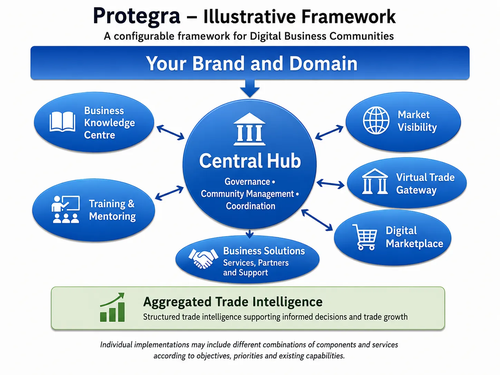
The Protegra Framework provides a flexible implementation framework that can be configured to reflect the objectives, priorities and operational requirements of each Business Community Owner.
The following sections introduce the principal operational components that may be incorporated within a typical Protegra implementation.
Important Note:
The diagram illustrates a typical Protegra implementation.
Individual Digital Business Communities may include different combinations of components, services, partners and delivery models, depending on organisational objectives, priorities and existing capabilities.
Many of the resources and services described are also available independently and can provide practical business support without implementing the complete Protegra Framework.
Existing services, digital platforms and business processes can normally be retained, integrated and expanded rather than replaced.
The Next Tab, Integrated Framework, explains how these components work together within a coordinated Digital Business Community.
An Integrated Framework
Although the Protegra Framework is presented as seven distinct components, these elements are designed to operate as a single integrated framework.
Information, knowledge, training, events, services, market visibility and commercial engagement are designed to support one another.
The objective is to make it easier for businesses to identify opportunities, access coordinated support and implement practical business solutions.
The Next Tab, Central Administration, introduces the coordination hub at the centre of a typical Protegra implementation.
Central Administration
The Central Administration function provides operational coordination within the Protegra Framework.
It helps manage communications, community engagement, programme administration and the coordination of Business Community activities.
Operational Coordination
Central Administration supports the day-to-day operation of the Protegra framework.
Examples may include:
- Subscription and registration management
- Helpdesk and user support
- Programme administration
- User and access management
- Operational coordination
Communications and Engagement
Effective communication is essential to maintaining an active and engaged Digital Business Community.
Central Administration helps coordinate communications between the Business Community Owner and participating businesses, supporting ongoing engagement and collaboration.
Structured newsletters, announcements and targeted communications help keep members informed about resources, events, opportunities, services and relevant developments.
Events and Community Activities
Webinars, workshops, briefings and other online or in-person events help maintain engagement and support the ongoing development of the Digital Business Community.
These activities encourage knowledge sharing, strengthen business relationships and provide opportunities to introduce new services, resources and market opportunities.
Technology and Platform Selection
A wide range of third-party technologies and service providers are available to support administration, communications, newsletters, events and community engagement.
Where suitable solutions are not already in place, one of the first implementation activities is to identify the capabilities required to support the Business Community Owner's objectives.
Appropriate technologies and service providers can then be selected and integrated within the Protegra Framework.
Knowledge Capture
Newsletters, webinars, reports, presentations and other resources can provide long-term value beyond their original purpose.
Where appropriate, these resources can be organised, retained and made available through the Business Knowledge Centre to support future learning, business development and organisational knowledge.
The Next Tab, Business Knowledge Centre, explains how information, resources and other knowledge assets can be organised, managed and made accessible throughout the Digital Business Community.
Business Knowledge Centre
The Business Knowledge Centre provides structured guidance, practical resources and reference materials that support Digital Business Communities, SME growth, business development and international trade.
It helps organisations and participating businesses move from knowledge to practical implementation by providing access to structured information, guidance and decision-support resources.
The Four Pillars of the Business Knowledge Centre
Sustainable business growth and international market development are supported by four interconnected capability areas.
The Business Knowledge Centre is organised around these four pillars.
Each pillar brings together structured guidance, practical resources and supporting publications to help organisations and SMEs strengthen business capability and achieve sustainable growth.
1. Business Readiness
Assess your organisation's readiness for sustainable business growth, digital engagement and market development.
Organisations should ensure they are strategically and operationally prepared for sustainable growth. This includes assessing organisational capabilities, developing business and market development strategies, understanding relevant regulatory requirements, and establishing appropriate operational, financial and risk-management arrangements to support domestic and international business activities.
2. Digital Business Visibility
Strengthen business visibility through multilingual digital presence, structured business information and online engagement.
Businesses are increasingly identified and evaluated through digital channels. Organisations should maintain a professional digital presence, multilingual content and structured business information to improve visibility and engagement. These capabilities support business growth, market development and international trade.
3. Digital Business Infrastructure
Understand the digital systems that support modern business operations, digital engagement and international trade.
Modern business increasingly depends on digital systems such as e-invoicing, digital documentation, electronic signatures, customer relationship management, business platforms and data-driven analytics. Organisations that adopt these capabilities can improve efficiency, transparency and competitiveness while strengthening their readiness for business growth and international trade.
4. Digital Business Communities
Understand how coordinated Digital Business Communities support SME growth, business collaboration, market development and trade development.
Digital Business Communities bring together the services, resources and coordinated support needed to strengthen SME engagement, business growth and market development. They provide a structured framework for long-term business development, international collaboration and trade development.
Information and Resource Management
Businesses often need access to knowledge, information and practical resources from multiple sources.
The Business Knowledge Centre helps organise these resources so they are easier to discover, access and use.
Examples include:
- Articles and practical guides
- Newsletters and briefings
- Webinars and recorded events
- Reports and research publications
- Reference resources
- Business support information.
Editorial Organisation
The value of a Business Knowledge Centre is determined not only by the quality of its content, but also by how that content is organised.
Resources can be organised around business challenges, use cases, sectors, technologies, markets or other priorities defined by the Business Community Owner, making information easier to discover, navigate and apply.
Learning and Implementation
The Business Knowledge Centre is designed to support the other components of the Protegra Framework.
Its resources can support training programmes, mentoring activities, events, business services, digital transformation initiatives and market development programmes.
Supporting Publications and Resources
The Business Knowledge Centre is complemented by a structured Resource Library containing implementation guides, checklists, technical papers, reference documentation and other practical resources.
Lists of available publications and resources can be provided during the Discovery Workshop or on request.
The Business Knowledge Centre can incorporate organisation-specific resources together with carefully selected third-party resources, tailored to the objectives, priorities and operational requirements of the Business Community Owner.
The Next Tab, Training & Mentoring, explains how knowledge, guidance and resources are transformed into practical skills, capability development and business support.
Training & Mentoring
Access to knowledge and information is essential.
However, implementing change often requires new skills, practical experience and ongoing support.
Training and Capability Development
Training programmes help businesses develop the capabilities needed to support business growth, digital transformation, market development and international trade.
Where appropriate, training can be delivered online, making learning more accessible regardless of location.
Examples include:
- Online courses
- Workshops and webinars
- Professional development programmes
- Certification programmes
Sector-specific training initiatives.
Mentoring and Practical Support
In some situations, businesses may benefit from additional guidance and practical support beyond formal training.
Mentoring programmes can help businesses understand available options, evaluate alternatives and implement appropriate solutions with greater confidence.
Examples include:
- One-to-one mentoring
- Sector specialists
- Business advisers
- Peer learning programmes
- Structured mentoring initiatives
Mentoring programmes may be delivered by Business Community Owners or through specialist organisations such as DHL GoTrade.
Integrated Learning and Support
Training and mentoring are most effective when complemented by relevant information, practical resources and ongoing guidance.
Learning can be reinforced through Business Knowledge Centre resources, recorded webinars, practical guides, reference materials and other supporting content.
The Next Tab, Market Visibility, explains how businesses can strengthen their market visibility and digital presence across domestic and international markets.
Market Visibility
Visibility is often the first step towards business engagement.
Before businesses can engage with customers, partners, investors, suppliers or other stakeholders, they first need a credible and visible digital presence.
Self-Help
Many businesses can significantly improve their market visibility by taking practical steps to review and strengthen their digital presence.
Examples include:
- Reviewing current digital visibility
- Improving company information and business profiles
- Strengthening website content
- Improving search visibility
- Increasing visibility in priority markets..
Microsites and Multilingual Microsites
Businesses seeking to strengthen their market visibility may also benefit from dedicated Microsites or Multilingual Microsites.
For organisations seeking to develop domestic and international markets, Multilingual Microsites help establish a structured multilingual digital presence across multiple countries and languages.
For organisations focused primarily on domestic markets, Microsites provide an additional digital presence while improving visibility within directories and Business Communities managed by the Business Community Owner.
Business Community Owner Support
Business Community Owners can further strengthen the market visibility of participating organisations through coordinated programmes, practical guidance and shared promotional activities.
Support may include:
- Market visibility reviews
- Digital presence assessments
- Content and profile guidance
- Awareness campaigns
- Sector or market-specific promotional initiatives
The level of support provided will depend on the objectives and resources of the Business Community Owner.
Business Profiles and Digital Identity
Business profiles serve purposes beyond visibility and promotion.
Structured business profiles provide a reusable source of business information that can support digital engagement, partner discovery, business development and market participation across multiple channels.
The same structured business information can support onboarding, supplier qualification, customer due diligence, Know Your Customer (KYC), Anti-Money Laundering (AML) and other business processes.
Information is maintained in a single location and can be shared with authorised third parties where appropriate.
This reduces duplication, improves consistency and simplifies participation across multiple Protegra services, programmes and business activities.
An Integrated Approach
Market Visibility is most effective when it operates as part of the wider Protegra Framework.
Market visibility initiatives can support Virtual Trade Gateways, trade missions, business events, Digital Marketplaces and other coordinated Protegra activities.
The most effective approaches combine business-led initiatives with coordinated support from the Business Community Owner.
The Next Tab, Virtual Trade Gateway, explains how increased visibility can be converted into business engagement, market access and business development opportunities.
Virtual Trade Gateway
The next step is creating meaningful engagement with potential customers, partners, suppliers and other stakeholders.
The Virtual Trade Gateway helps convert market visibility into business engagement, collaboration and commercial opportunities.
Business Engagement
The Virtual Trade Gateway provides structured opportunities for businesses to engage with potential customers, partners, suppliers, investors and other stakeholders.
Examples include:
- Virtual trade events
- Trade missions
- Business matching activities
- Partner introductions
- Trade briefings
- Sector-focused business events.
Commercial Platforms
A wide range of third-party commercial platforms can support business engagement, collaboration and commercial activity within the Virtual Trade Gateway.
Examples include:
- Opportunity platforms
- Procurement platforms
- Contracting platforms
- Project collaboration platforms
- Business networking platforms
Trade and Project Management
Additional tools can support the management of commercial relationships, projects and ongoing business activities.
Examples include:
- Contract management
- Contract tracking
- Project management and tracking
- Collaboration tools
- Workflow management systems
An Integrated Approach
The Virtual Trade Gateway works in close coordination with the other components of the Protegra Framework.
- Market Visibility helps businesses establish a credible digital presence and attract market interest.
- The Virtual Trade Gateway helps initiate business engagement, communication and collaboration.
- Business Solutions and the Digital Marketplace support the practical development and delivery of commercial opportunities.
Flexible Deployment
Different Protegra implementations may incorporate different event platforms, collaboration tools, contracting systems, procurement platforms and business engagement solutions.
The most appropriate combination will depend on the objectives, priorities and operational requirements of the Business Community Owner.
The Next Tab, Business Solutions, explains how specialist business services can help organisations implement, manage and support commercial activities.
Business Solutions
Businesses often encounter practical challenges that require specialist support.
- In some situations, businesses already know the type of service or provider they require.
- In other situations, businesses understand the challenge they face but need assistance in identifying the most appropriate solution.
The Business Solutions component helps businesses identify relevant services, specialist providers and practical solutions that support business growth, market development and commercial activities.
Solution Categories
Depending on the challenge, businesses may require support from different specialist service providers.
Examples include:
- Finance and funding
- Payments and foreign exchange
- Logistics and supply chain services
- Customs and regulatory compliance
- Legal and professional services
- Insurance and risk management
- Translation and localisation services
- Marketing and communications
- Digital technology providers..
Guidance and Support
The Business Solutions component works in close coordination with the Business Knowledge Centre, Training & Mentoring and the other components of the Protegra Framework.
Through this coordinated framework, businesses can access guidance, learning resources, implementation support and specialist service providers.
Implementation Flexibility
Different Business Community Owners may utilise different service providers, partners, resources and delivery models according to their objectives, priorities and operational requirements.
The objective is to make appropriate solutions easier to identify, evaluate and implement.
The Next Tab, Digital Marketplace, explains how businesses, buyers, suppliers and service providers can engage within a structured environment that supports business collaboration and commercial opportunities.
Digital Marketplace
The Digital Marketplace provides a structured environment for business and commercial engagement.
It helps organisations identify and connect with potential customers, suppliers, partners, service providers and other organisations that support their business objectives.
A Progressive Development
The Digital Marketplace is typically introduced once the core components of the Protegra Framework have been established.
The Business Knowledge Centre, Training & Mentoring, Market Visibility, the Virtual Trade Gateway and Business Solutions all help prepare organisations for effective participation in the Digital Marketplace.
Commercial Interaction
Examples include:
- Buyer and supplier discovery
- Business opportunity sharing
- Tender and procurement opportunities
- Project opportunities
- Specialist service provider directories
- Partner identification and matching
- Commercial collaboration..
Flexible Approaches
Different Business Community Owners may adopt different Digital Marketplace models according to their objectives, priorities and operational requirements.
Examples include:
- Business directories
- Procurement platforms
- Sector-specific marketplaces
- Partner matching platforms
- Business networking platforms.
An Integrated Environment
The Digital Marketplace operates in close coordination with the other components of the Protegra Framework.
- Market Visibility helps businesses establish a credible digital presence and attract market interest.
- The Virtual Trade Gateway supports business engagement, introductions and commercial collaboration.
- Business Solutions help businesses identify, evaluate and implement appropriate solutions.
Together, these components create a coordinated business environment that supports commercial engagement, market development and sustainable business growth.
Implementation Flexibility
Different Protegra implementations may incorporate different Digital Marketplace solutions according to the objectives, priorities and operational requirements of the Business Community Owner.
The most appropriate implementation will reflect the needs of the organisation and the characteristics of its Digital Business Community.
The Next Tab, Key Considerations, summarises the principal considerations for planning, implementing and developing a Digital Business Community using the Protegra Framework.
Key Considerations
The seven Protegra components illustrate a typical implementation of the Protegra Framework.
- Different implementations may incorporate different combinations of components, services, resources, partners and delivery models.
- Protegra is designed to be modular, adaptable and implemented progressively.
- Existing capabilities can be retained, integrated and expanded where appropriate.
- The objective is not to replace existing services, resources or digital infrastructure.
- The objective is to make these capabilities easier to identify, access, coordinate and use.
- The value of Protegra does not arise from the individual components alone.
- It arises from the integration and coordination of those components within a single, coherent framework.
Successful implementations focus on practical business challenges and measurable business outcomes rather than technology alone.
The components described above illustrate how the Protegra Framework provides a structured framework for supporting SME growth, business development, market development and trade development.
The Next Tab, Opportunity Dashboard, demonstrates how businesses and organisations can identify and evaluate international market opportunities.
The Protegra Opportunity Dashboard
The Protegra Opportunity Dashboard enables organisations and businesses to identify, evaluate and shortlist international market opportunities using structured country information.
Shortlisted opportunities can then be explored further through country profiles, ATIM Trade Reports and other trade development resources.
Dashboard Component
(Available as part of the Protegra Framework upon request.)
Demonstrator Scope
The Opportunity Dashboard provides a simple demonstration of how structured country information can support the identification and evaluation of international market opportunities.
The filters and outputs are illustrative only. Protegra dashboards can be configured to reflect the objectives, priorities, data sources and operational requirements of individual Business Community Owners.
Organisation-Specific Implementations
Protegra implementations can incorporate organisation-specific and third-party data sources to support the objectives and operational requirements of individual Business Community Owners.
Examples include trade data, customer activity, digital visibility indicators, event participation, institutional information and other relevant business datasets.
The countries identified through the Opportunity Dashboard provide a structured starting point for market review, country prioritisation and international market assessment.
Potential Next Steps
Review detailed country profiles and relevant institutional information.
- Shortlist priority countries that align with your business objectives.
- Use ATIM Trade Reports to identify priority sectors, products, markets and trade corridors.
- Identify relevant business, institutional and trade development partners.
- Participate in trade missions, business matching activities and other trade development programmes.
- Develop market visibility and business engagement activities within selected markets.
Future Development
Future versions of the Opportunity Dashboard may incorporate additional trade intelligence, digital visibility, institutional information and market intelligence capabilities.
If you would like to discuss how the Protegra Framework and a Digital Business Community could support your organisation, please contact us at Protegra@tradetech.cloud.