Structured International Trade Reports
ATIM Trade Reports provide structured international trade intelligence designed to support market analysis, industry review, trade-development planning and opportunity identification.
ATIM currently supports two complementary report families s:
1. Merchandise Trade Reports
Supporting analysis across 228 countries and territories and 97 HS2 merchandise groups using international merchandise trade statistics and Harmonised System (HS) classifications..
2. Services Trade Reports
Supporting analysis of selected countries and BPM6 service categories using international trade in services statistics where suitable data is available.
Reports are available at global, country, bilateral, industry, product-category and trade-corridor levels, providing a consistent analytical framework for a wide range of trade-intelligence requirements
Multilingual versions are available on request.
ATIM reports help organisations:
- identify international markets, industries, and trade opportunities;
- understand international trade patterns and growth trends;
- evaluate markets, sectors, and trade corridors; and
- identify practical next steps for further investigation and implementation.
The Next Tab, Sample Reports, provides examples of the principal ATIM report families.
Sample Reports & Report Families
ATIM currently supports two complementary report families. Together, these report structures support market analysis, industry review and trade-development planning.
These sample reports, together with their supporting Global Trade Flow Tables, are available on request.
Merchandise Trade Reports
Product-Centric
- World Product Trade Report: HS85 – Electrical Machinery and Equipment
- Country Product Trade Report: HS85 – Electrical Machinery and Equipment: Philippines in the Global Context
- Bilateral Product Trade Report: HS85 – Electrical Machinery and Equipment: Philippines – Vietnam
Country-Centric
- World Market Trade Report: World Merchandise Trade – All Product Sectors
- Country Trade Report: Philippines and the World Merchandise Market
- Bilateral Trade Report: Philippines and Vietnam Bilateral Merchandise Report
Services Trade Reports
Service-Centric
- World Service Sector Report: World Market - BPM6-09 Telecommunications, Computer and Information Services
- Country Service Sector Report: Italy - BPM6-09 Telecommunications, Computer and Information Services
Country-Centric
- World Service Trade Report: World Trade in Services – All Service Categories
- Country Service Trade Report: India – All Service Categories
Additional Report Structures
The ATIM framework also supports analysis involving regional trade blocs, economic groupings, customised combinations of countries and industries, as well as trade corridors.
All ATIM reports are supported by Global Trade Flow Tables, classification resources, methodology notes and related analytical materials.
These resources provide access to the underlying trade-flow data, rankings, concentration measures, growth indicators and supporting references used throughout ATIM Trade Reports.
The Next Tab, Using ATIM Trade Reports, explains how individual ATIM reports can be used together to support progressively more detailed market, industry and bilateral trade analysis.
Using ATIM Trade Reports
ATIM reports are designed to support progressive investigation and analysis.
Rather than relying on a single report type, organisations can move from broad international analysis to increasingly focused market, industry and bilateral trade analysis.
ATIM currently supports two report families:
- Merchandise Trade Reports
- Services Trade Reports
Merchandise Trade Reports can be analysed from two complementary perspectives:
- Product-Centric Analysis
- Country-Centric Analysis
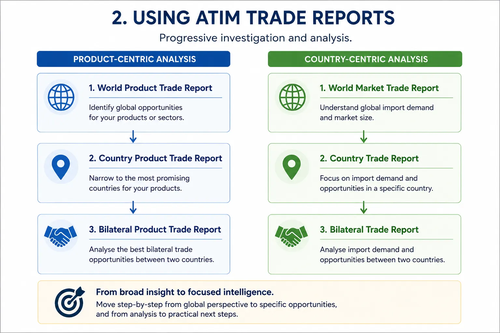
Together, these two perspectives provide six complementary report types that can be used individually or in combination to support progressively more detailed trade analysis..
Product-Centric Analysis
Product-centric analysis typically begins with a World Product Trade Report.
This report identifies the principal international markets, growth benchmarks, trade concentration patterns and product-sector activity associated with a specific HS2 product sector.
Where particular countries appear relevant, Country Product Trade Reports provide more detailed analysis of national participation within the selected product sector.
Where specific trading relationships merit further investigation, Bilateral Product Trade Reports examine trade activity between two countries within the selected product sector.
Typical progression
World Product Trade Report
→ Country Product Trade Report
→ Bilateral Product Trade Report
Typical analytical workflow
→ Identify markets of interest
→ Assess a country's participation within the selected product sector
→ Examine bilateral opportunities between specific trading partners
Country-Centric Analysis
Country-centric analysis typically begins with a World Merchandise Trade Report.
This report provides comparative analysis across reporting countries and identifies countries demonstrating notable international trade activity and growth.
Where particular countries appear relevant, Country Trade Reports provide more detailed analysis of markets, product sectors and trade relationships.
Where specific trading relationships merit further investigation, Bilateral Trade Reports identify product sectors that may benefit from additional trade-development activity.
World Merchandise Trade Report
→ Country Trade Report
→ Bilateral Trade Report
Typical analytical workflow:
→ Identify countries of interest
→ Review national trade performance and sector activity
→ Examine bilateral trade relationships and product-sector opportunities
Services Trade Reports
ATIM Services Trade Reports support progressive analysis of international trade in services using BPM6 service classifications.
Services analysis can be approached from either a country-centric or a service-centric perspective.
Typical progression:
World Service Trade Report
→ Country Services Trade Report
or
World Service Sector Report
→ Country Services Sector Report
These reports support market analysis, industry review, opportunity identification, and trade-development planning within international services markets.
Typical Applications
ATIM Trade Reports can support:
- market-selection activities;
- industry-prioritisation exercises;
- trade-mission planning;
- trade-event development;
- trade-corridor identification;
- exporter and buyer targeting;
- member and client engagement;
- trade-development programme design; and
- international market-development initiatives.
Progressive Analysis
By combining different report types, organisations can move progressively from broad international analysis to increasingly focused market, industry, and bilateral trade analysis.
The result is a structured trade-intelligence process that supports prioritisation, investigation, and trade-development planning.
The Next Tab, Institutional Intelligence, explains how ATIM Trade Reports can be combined with institution-specific information to support more targeted analysis, planning, and engagement.
Institutional Intelligence
ATIM Trade Reports provide structured international trade intelligence derived from international trade datasets and supporting analytical resources.
These reports can be used as standalone analytical resources or enhanced with institution-specific information and data.
From Macro Intelligence to Institutional Intelligence
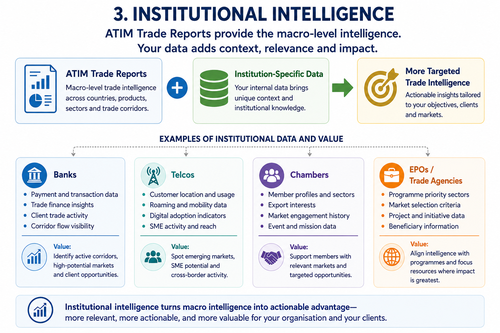
ATIM Trade Reports provide macro-level trade intelligence relating to markets, industries, countries, bilateral trade relationships, trade corridors and trade blocs.
When combined with organisation-specific information and data, this intelligence can support more targeted analysis, planning and engagement
Examples of institution-specific information and data include:
- BICDetective payment-flow intelligence;
- Google Search Console data;
- Microsite and Multilingual Microsite visibility and demand signals;
- member and client datasets;
- event and engagement data; and
- other institutional information sources.
More Targeted Trade Development
Combining international trade intelligence with institution-specific information and data supports more focused trade-development planning.
The result is a clearer understanding of markets, industries, trade corridors and priorities that are directly relevant to the organisation and its stakeholders.
The Next Tab, Analytical Approach, explains how ATIM Trade Reports support structured investigation, analysis and informed decision-making.
Analytical Approach
ATIM Trade Reports are designed as components of a broader trade-intelligence framework rather than as isolated analytical outputs.
The objective is not simply to present international trade statistics, but to support structured investigation, analysis, prioritisation and trade-development planning.
Structured Analysis
ATIM applies a consistent analytical framework across countries, industries, bilateral trade relationships, trade corridors and trade blocs.
This enables reports to be compared, combined and expanded using a common methodology and reporting structure.
The result is a flexible trade-intelligence capability that supports progressively more detailed analysis as priorities emerge.
Evidence-Based Intelligence
ATIM does not attempt to predict outcomes or prescribe actions.
Instead, it provides structured trade intelligence that supports investigation, analysis, comparison, prioritisation and informed decision-making.
The framework enables organisations to evaluate markets, industries, countries and bilateral trade relationships using a consistent analytical methodology.
This supports evidence-based trade-development planning, programme design, market selection, industry prioritisation and trade-corridor development.
From Intelligence to Action
ATIM Trade Reports are designed to identify markets, industries, countries and bilateral trade relationships that merit further investigation.
Rather than attempting to provide all possible answers within a single report, the framework supports a structured process of investigation, analysis, prioritisation and follow-up.
Trade Reports represent one component of a broader trade-intelligence capability that supports market discovery, informed decision-making and trade-development planning.
Connected Resources
ATIM Trade Reports form part of a broader trade-intelligence and trade-development framework.
Where additional investigation is required, ExportersAlmanac provides country, industry, institutional and international trade reference resources.
Protegra helps transform trade intelligence into practical trade-development activity.
Together, these complementary components support informed decision-making and coordinated trade-development action.
The Next Tab, Methodology, explains the analytical framework, methodology and reporting principles used to produce ATIM Trade Reports.
Methodology
ATIM Trade Reports use a structured analytical framework designed to support consistent, repeatable and transparent international trade analysis.
Scope
ATIM currently supports two complementary report families:
Merchandise Trade Reports
- Based on international merchandise trade statistics and Harmonised System (HS) product classifications.
- Support analysis across more than 228 countries and territories and 97 HS2 product groups.
Services Trade Reports
- Based on international trade in services statistics and BPM6 service classifications.
- Support analysis of selected countries and service categories where suitable data is available.
Analytical Framework
ATIM applies a consistent analytical framework across all report types.
This enables countries, industries, bilateral trade relationships, trade corridors and trade blocs to be analysed using comparable analytical structures, metrics and reporting principles.
Report Structures
ATIM Trade Reports can be used independently or combined to support progressively more detailed market, industry, country and bilateral trade analysis.
This modular report structure enables organisations to apply a consistent analytical methodology while increasing the level of detail as investigation progresses.
Reporting Principles
ATIM Trade Reports are intended to support structured investigation, analysis, prioritisation and trade-development planning.
The reports identify markets, industries, countries and bilateral trade relationships that may merit further investigation.
They are designed to support informed decision-making and should not be interpreted as commercial, financial, legal, investment or other professional advice.
ATIM Trade Reports represent one component of a broader trade-intelligence and trade-development framework.
Together with ExportersAlmanac and Protegra, ATIM Trade Reports support structured investigation, informed decision-making, and coordinated trade-development activity.
If you would like to discuss how ATIM Trade Reports could support your organisation, please contact us at ATIM@tradetech.cloud.