Protegra – Overview
PROsperity through Technology-Enabled Growth, Reach and Access
Protegra provides organisations supporting SMEs with a practical framework for implementing a Digital Business Community.
The Protegra Framework provides a structured approach to designing, launching and growing Digital Business Communities.
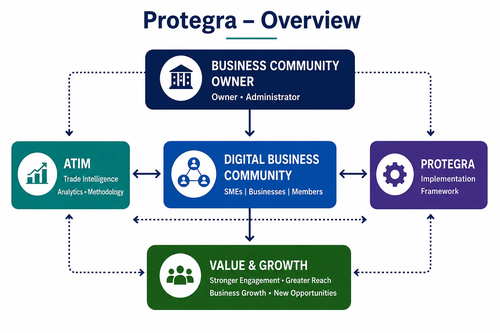
The diagram above illustrates how Protegra coordinates the principal components of a Digital Business Community. The following sections explain the business challenge that this framework has been designed to address.
The Challenge – Unlocking the potential of your SME base
Organisations already provide valuable services, including finance, training, advisory support, business networks and market access. These services often exist across multiple providers, platforms and programmes.
For SMEs, identifying the right information, resources, services and opportunities can be difficult.
The challenge is to increase SME participation, engagement and business growth.
Many SMEs perceive business growth, digital transformation, market development and exporting as complex and risky. To engage them successfully, organisations must present credible business opportunities alongside the knowledge, services and support needed to realise them.
This creates a dual requirement:
- Identify credible business opportunities.
- Coordinate the knowledge, services and support needed to realise them.
Most SMEs already have significant growth potential. What they often lack is visibility, structure and coordination.
The Solution
Protegra brings fragmented knowledge, services, business networks and support activities together within a single coordinated framework.
It provides Business Community Owners with a structured environment through which they can communicate, engage proactively with and support their business community.
Business Community Owners are supported through a structured approach to coordinating trusted business information, business knowledge resources, member engagement and continuous community development. Information from multiple trusted contributors can be coordinated and delivered through the most appropriate channels, helping organisations provide greater value to their SME communities. Technology and, where appropriate, AI-assisted tools support these activities without requiring specialist expertise within the organisation.
This creates an environment in which businesses can more easily identify opportunities, access practical support and participate in sustainable business growth and trade development.
Following the Discovery Workshop, the recommended implementation is tailored to reflect the Business Community Owner's objectives, operational requirements and local operating environment.
The Next Tab, Core Components, introduces the principal elements of the Protegra Framework and explains how they work together to implement a Digital Business Community.
Core Components
The Protegra Framework combines two complementary capabilities:
- ATIM – provides trade intelligence, community intelligence and analytical insights that help identify markets, opportunities and priorities.
- Protegra – provides the implementation framework that helps Business Community Owners engage their SME community, coordinate support activities and convert opportunities into measurable business growth. It is designed to accommodate complementary third-party platforms, applications and specialist services that enhance the Business Community Owner's service offering.
ATIM identifies where opportunities exist. Protegra provides the framework through which those opportunities are developed and realised.
The Next Tab, The Protegra Solution, explains how the framework supports active community management, coordinated business support and sustainable business development.
The Protegra Solution
Protegra provides the implementation framework used to establish and operate Digital Business Communities. It coordinates the services, resources and capabilities required to support SME growth and business development.
Illustrative Components of a Protegra Implementation
Protegra combines the essential elements within a coordinated framework:
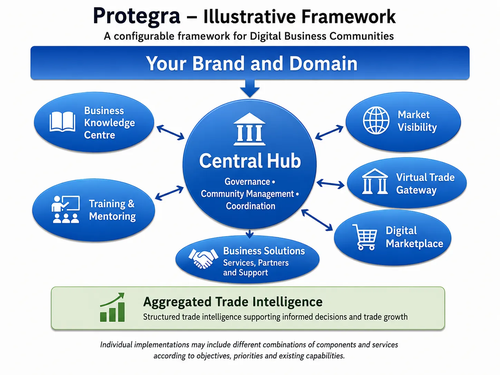
Institutional Coordination
- Central Administration
Governance, coordination and operational management of the Digital Business Community.
Knowledge & Capability
- Business Knowledge Centre
Structured trade knowledge and decision-support resources - Training and Mentoring
Business capability development and practical guidance
Market Access & Engagement
- Market Visibility
International discoverability across languages and markets - Virtual Trade Gateway
Structured digital access to international business opportunities
Business Support & Commercial Engagement
- Business Solutions
Access to trusted specialist providers supporting business and trade operations. - Digital Marketplace
Structured commercial engagement and partnership development
The components shown represent a typical implementation. The Discovery Workshop determines which components are included during the Foundation Phase, how they are configured and how they are integrated with the Business Community Owner's existing services and digital infrastructure.
The real value of Protegra comes from the way these components are integrated into a coordinated framework.
Protegra also builds on the trusted business relationships that Business Community Owners already have with their SME communities. This creates a stronger foundation for digital collaboration, business networking and future AI-enabled services by helping organisations engage with known business participants rather than anonymous online participants.
Addressing the Six Structural Trade Challenges
These are embedded within the infrastructure, removing the need for SMEs to coordinate them independently:
- Buyer–supplier connectivity — structured introductions and matching
- Cross-border communication — multilingual engagement channels
- Risk management — coordinated advisory and support
- Logistics and supply chains — integration of trusted partners
- Finance and pricing — aligned financial and commercial frameworks
- Documentation and digital processes — streamlined compliance and digitalisation
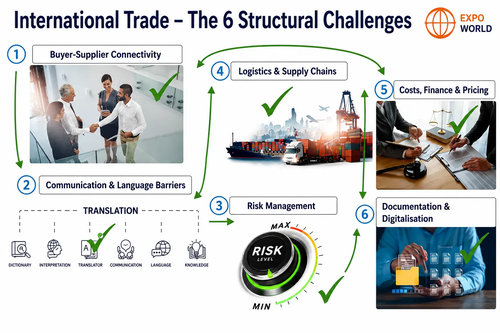
Protegra integrates these elements into a single coordinated framework.
The Next Tab, Strategic Value, explains the strategic and operational value of the Protegra Framework and how it strengthens SME engagement, business development and long-term growth.
Value
Protegra enables organisations to move from fragmented service delivery to coordinated support for SME growth, business development and trade development.
By implementing a Digital Business Community through the Protegra Framework, organisations can strengthen both the reach and effectiveness of their SME support.
Key outcomes:
Strengthened Engagement with the SME Community
Continuous visibility and engagement create ongoing interaction between SMEs, markets and support organisations, extending engagement beyond one-off programmes and events.
Expanded Service Delivery Without Increasing Complexity
Digital infrastructure enables organisations to scale support across their SME base without proportionally increasing internal resources or operational complexity.
Generation of Actionable Market Intelligence
Aggregated engagement data provides insights into demand, interests and market trends, supporting evidence-based decision-making.
More Targeted and Effective Support Programmes
Organisations can align training, advisory services, trade missions and partner support with real market signals rather than assumptions or historical data.
Measurable Economic Impact
By linking visibility, engagement and support services, organisations can more clearly demonstrate outcomes in terms of SME growth, business development and trade development.
Strategic Positioning as a Digital Trade Enabler
Implementing a Digital Business Community positions the organisation as a strategic facilitator of business growth, business development and trade development, rather than a provider of isolated services.
The Next Tab, Operational Model, explains how the Protegra Framework operates in practice and how its components work together to deliver coordinated support and transform trade intelligence into practical business outcomes.
Operational Model
The Protegra Framework operates as a coordinated system that connects SMEs with domestic and international markets, business partners and specialist support services
Protegra is deployed as a partner-owned platform, tailored to each organisation and implemented under its own domain.
Protegra is supported by a range of services including:
- Multilingual Microsites — providing structured international visibility and generating measurable engagement data
- Business Knowledge Centre — providing structured knowledge, practical guidance and access to curated trade resources
These services complement the Business Community Owner's own services, tools and data, integrating them within the Protegra Framework to support a coordinated Digital Business Community.
The relationship between these elements is illustrated below.
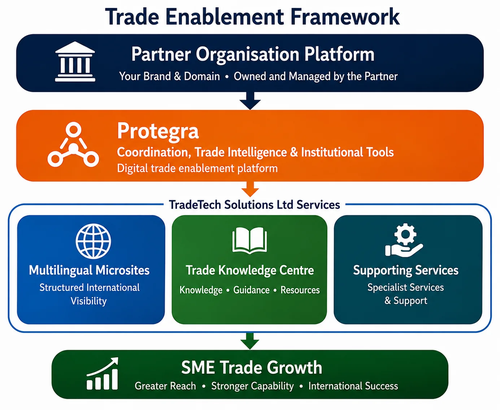
This framework illustrates how visibility, services and data work together within a coordinated framework.
Operational Components
The Protegra Framework operates through several complementary operational components:
Market Visibility
Participating SMEs gain a structured multilingual digital presence, enabling international buyers, business partners and investors to discover their capabilities across multiple markets.
While each Multilingual Microsite strengthens the visibility of an individual company, the Protegra Framework also creates an aggregated company discovery layer that significantly extends overall visibility and reach.
Aggregated Company Discovery
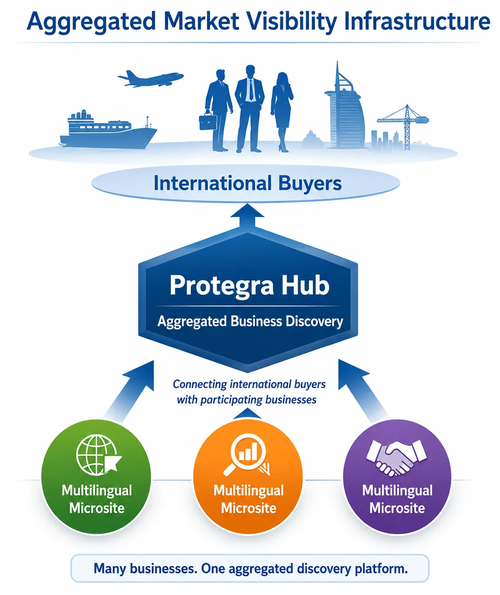
Each SME is represented through its own Multilingual Microsite, while the aggregated portal provides a central company discovery gateway.
This structure enables international users to discover participating companies by sector, product category or country.
As participation grows, the aggregated portal becomes an increasingly valuable international company discovery layer.
Aggregated Trade Intelligence
International engagement generates structured data that can be analysed through ATIM to identify market activity, demand patterns and emerging opportunities.
Institutional Intelligence Dashboards
Participating organisations receive aggregated insights that support programme planning and decision-making through ATIM
From Digital Visibility to Trade Outcomes
Together, these operational components demonstrate how the Protegra Framework supports coordinated SME engagement while enabling ATIM to transform engagement data into actionable trade intelligence.
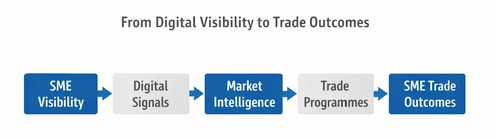
International visibility and engagement generate structured data that is analysed through ATIM to produce actionable trade intelligence, while maintaining Business Community Owner ownership of company-level data.
For further details on data ownership, GDPR compliance and analytics, please refer to the Digital Business Community FAQs.
The Next Tab, Connecting Existing Services, explains how the Protegra Framework builds on existing services, systems and digital infrastructure rather than replacing them.
Connecting Existing Services
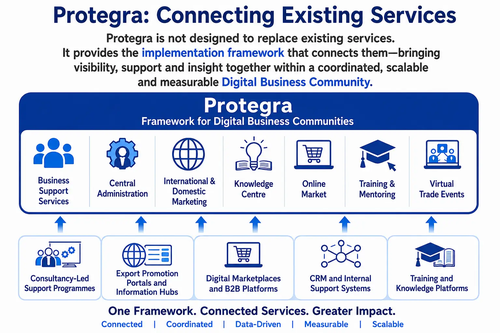
Most organisations already provide valuable services, programmes and support to their SME base. The Protegra Framework builds on these existing capabilities rather than replacing them.
Protegra coordinates these services so they work more effectively together to create an active Digital Business Community.
The Next Tab, Implementation Framework, explains how the Protegra Framework is implemented through the Discovery Workshop, Foundation Phase and Progressive Expansion.
Implementation Framework
Protegra is implemented through a structured methodology that enables organisations to deploy and expand a Digital Business Community progressively, with minimal disruption.
A practical and accessible approach
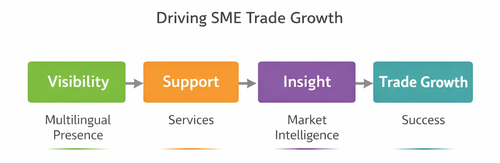
In practical terms, this enables your organisation to support SMEs not only with services, but also through visibility, engagement and measurable market feedback.
Protegra is designed to be:
- Quick to implement
- Low complexity
- Modular and scalable
It does not require significant investment in new technology or internal development. Organisations can begin with a focused Foundation Phase and expand progressively over time.
Implementation typically begins with a review of the organisation's existing services and programmes. Protegra is designed to integrate with existing initiatives—including training programmes, export advisory services, trade missions and partner networks—strengthening and extending their impact rather than replacing them.
Deployment normally begins by establishing the Digital Business Community, enabling participating SMEs to create domestic and multilingual international visibility while simultaneously generating aggregated engagement data for analysis through ATIM.
This approach delivers practical value from the outset while providing a structured foundation for Progressive Expansion.
The framework below illustrates how Protegra can be implemented progressively, with each successive stage building on the previous one.
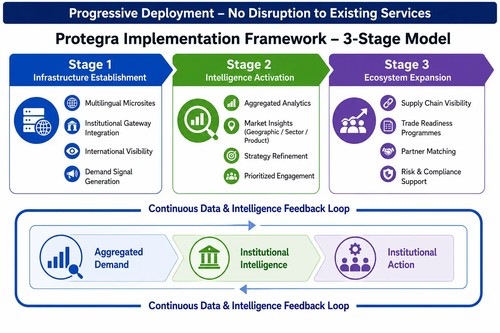
These three stages are outlined below.
Stage 1 – Infrastructure Establishment
(Creating the multilingual visibility and data foundation.)
Participating SMEs are provided with Multilingual Microsites and integrated into the Digital Business Community.
This immediately:
- Establishes domestic and international visibility
- Establishes a structured multilingual digital presence
- Begins generating aggregated demand signals
This stage establishes the visibility and data foundation for the entire Digital Business Community.
Stage 2 – Intelligence Activation
(Generating market insights and demand signals.)
Aggregated analytics begin to reveal:
- Geographic demand patterns
- Sector-level engagement
- Product-level interest
Institutions can use these insights to:
- Refine export promotion strategies
- Prioritise international engagement
- Align programmes with measurable demand
This stage transforms engagement data into actionable trade intelligence through ATIM.
Stage 3 – Ecosystem Expansion
(Extending services, collaboration and institutional capabilities.)
Once the Foundation Phase is established, additional Protegra modules can be progressively deployed, including:
- Supply-chain visibility tools
- Trade readiness programmes
- Partner matching tools
- Risk and compliance support services
This stage enables organisations to progressively expand a fully integrated Digital Business Community based on validated demand signals and market intelligence.
Implementation Logic
This phased approach enables organisations to begin with a practical operational foundation while progressively expanding capabilities over time.
It reduces complexity, minimises upfront resource requirements and ensures that each stage is guided by real market intelligence rather than assumptions.
Enabling Delivery at Scale
Advances in AI, SaaS architecture and digital platforms make it possible to deliver coordinated business support efficiently and at scale.
Protegra enables organisations to deliver this support in a structured and scalable way across their SME communities, combining international digital visibility with aggregated engagement data that can be analysed through ATIM to identify emerging demand and market opportunities.
Institutional Engagement and Ongoing Activity
The effectiveness of a Digital Business Community depends on active institutional engagement. Its value increases over time as participation, content quality and community engagement continue to grow.
While Protegra provides the digital framework for domestic and international visibility, coordination and insight, its impact is maximised when organisations:
- Actively onboard and support participating SMEs.
- Encourage regular content updates and the maintenance of structured company information.
- Integrate the framework into existing programmes, services and outreach activities.
In this context, Protegra should be understood as an enabling infrastructure that strengthens and amplifies institutional activity rather than replacing it.
Further details on implementation models, resource requirements and technology options are available in the Protegra FAQs.
Organisations seeking to strengthen SME engagement, business growth and trade development through a Digital Business Community are invited to explore potential collaboration with TradeTech Solutions.
The Protegra section concludes with Inside Protegra, which provides additional detail on the operational components and capabilities that can be incorporated into a Digital Business Community.