Overview
MarketPilot: Transforming SME Relationships into Digital Business Communities.
Digital Business Communities go beyond simple business networking. They strengthen, support, and develop your SME relationships.
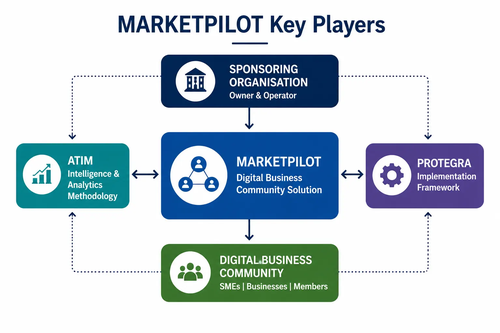
MarketPilot provides the digital tools, intelligence, content, and support services needed to build and sustain your Digital Business Community.
Why Digital Business Communities?
Many organisations are looking to strengthen SME engagement, deliver greater value, and develop new business opportunities. At the same time, SMEs increasingly require practical support to increase sales, reduce digital complexity, and improve access to opportunities, services, and finance.
Digital Business Communities help bridge this gap by providing practical support and business-development resources to SMEs.
They help SMEs to:
- increase sales and business opportunities;
- reduce costs and complexity; and
- improve access to suppliers, service providers, and finance.
As a result, your organisation can:
- develop new revenue opportunities;
- deliver differentiated value-added services; and
- strengthen customer or member attraction, engagement, and retention.
The Next Tab, The Structural Challenge, explores why information, services, networks, and opportunities often exist in isolation, and how this fragmentation can limit SME growth and market development.
The Structural Challenge
Most SMEs do not suffer from a lack of information, services, or opportunities.
They suffer from fragmentation.
Information, services, networks, and opportunities usually exist in isolation.
As a result, SMEs must identify, evaluate, and coordinate these resources themselves.
This increases complexity, cost, and implementation risk.
A Fragmented Environment
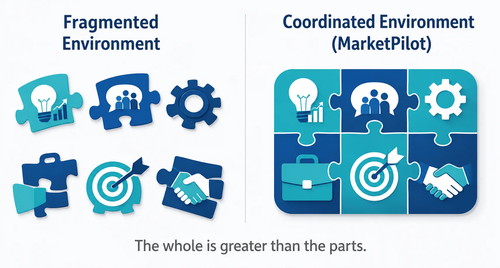
Although individual services can provide value, greater value is created when resources, services, networks, and opportunities are coordinated within a structured framework.
Protegra has been developed to help address this challenge by connecting existing capabilities within a coordinated environment.
The Next Tab, SME Export Challenges, examines the specific challenges SMEs face when developing export opportunities and participating in international trade.
SME Export Challenges
Across international markets, SMEs face a consistent set of barriers to export growth. Many have international potential, but relatively few develop sustained export activity. In most cases, the limitation is not capability, but the structure of the export environment itself.
Key Constraints Affecting SME Export Growth
Several recurring constraints limit SME participation in international markets:
Absence of Structured Export Planning
Many SMEs operate successfully in domestic markets but lack a formal approach to identifying and developing international opportunities.
Perceived Complexity and Cost
International trade is often viewed as administratively complex, legally uncertain and financially risky—particularly for companies with limited internal resources.
Market Entry Risk
Traditional export approaches require SMEs to select target markets and commit resources before any evidence of demand exists, creating disproportionate commercial risk.
Fragmented Support Structures
Although many export support services exist, they are rarely integrated. Few organisations provide coordinated support across the full export process, from market discovery to completed transactions.
As a result, many SME export initiatives fail to progress beyond initial exploration.
Addressing the Structural Challenge
The core issue is not lack of information or support services. It is lack of coordinated infrastructure.
SMEs may have access to individual services, but often lack the coordination required to connect visibility, support, partners, and market opportunities into a coherent export-development system.
These constraints arise because SMEs must navigate a set of essential international trade functions without integrated support.
The 6 Key Challenges to International Trade
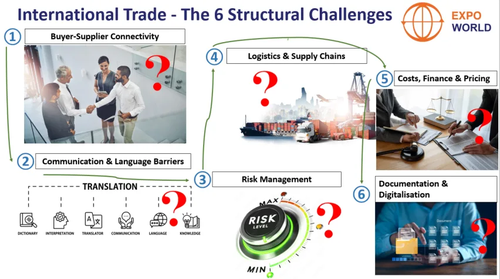
Each of these functions represents a critical component of successful international trade.
When delivered through fragmented providers, SMEs are required to coordinate them independently— increasing cost, complexity and execution risk.
The Next Tab, How MarketPilot Works, explains how MarketPilot addresses these challenges by connecting visibility, support services, trade intelligence, and engagement within a coordinated framework.
How MarketPilot Works
MarketPilot combines intelligence, implementation, and business-support capabilities within a Digital Business Community Solution.
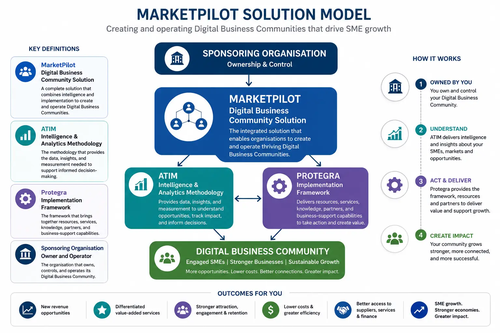
As illustrated above, the MarketPilot solution comprises three principal components:
- MarketPilot: Digital Business Community Solution
- ATIM: Trade Intelligence & Analytics
- Protegra: Implementation Framework
Together, these components create a coordinated Digital Business Community Solution.
From Data to Measurable Outcomes
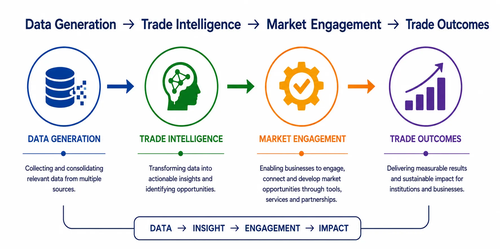
The three components work together to transform visibility and demand signals into intelligence, intelligence into action, and action into measurable outcomes.
The Next Tab, Deployment, explains how MarketPilot can be implemented progressively with minimal IT disruption.
Modular Deployment
MarketPilot is designed as a modular solution, allowing phased deployment aligned to institutional priorities.
Key Principles
- Independent Modules
Each module can be deployed separately - Integration with Existing Systems
Works alongside existing platforms and services - No Replacement Requirement
Existing systems remain in place - Progressive Scaling
Start small and expand
Minimal IT Disruption
MarketPilot enhances and coordinates existing capabilities rather than introducing complex new systems.
The Next Tab, Phase One, provides a practical example of how MarketPilot can be deployed quickly and begin delivering value.
Phase One Implementation
A Practical Starting Point
MarketPilot is designed to support phased implementation.
Organisations can begin with a focused initial phase that delivers practical value while establishing the foundations for future growth.
1. Define Strategic Priorities
Identify the areas of greatest interest and relevance.
Examples may include:
- sectors;
- products;
- geographic markets;
- member or client segments; and
- institutional priorities.
2. Establish Trade Intelligence Capability
Configure ATIM to support analysis and decision-making.
Examples include:
- market selection;
- sector analysis;
- product analysis;
- trade corridor analysis; and
- opportunity identification.
3. Deploy Data Generation
Support visibility, business profiling, and demand-signal generation.
Examples include:
- distributing Microsites & Multilingual Microsites to members or clients;
- increasing market visibility;
- generating demand signals; and
- establishing a structured data foundation.
4. Align Execution Capability
Use Protegra to coordinate existing resources, services, programmes, and partnerships. .
Examples include:
- knowledge resources;
- training programmes;
- visibility initiatives;
- engagement activities; and
- business-support services
5. Connect Intelligence to Action
Use intelligence outputs to support practical engagement activities.
Examples include:
- member engagement;
- client activation;
- market-development initiatives;
- trade-development activities; and
- opportunity follow-up.
Additional Capability for Banks
Banks may also choose to incorporate payment-flow intelligence through BICDetective.
This can support:
- client intelligence;
- corridor analysis;
- opportunity identification; and
- portfolio segmentation.
Outcome of Phase One
- initial intelligence outputs;
- increased visibility;
- member or client engagement;
- demand-signal generation; and
- a scalable foundation for future growth.
The Next Tab, Value, summarises the strategic and operational benefits for telcos, banks, chambers of commerce, and trade associations.
Institutional Value
A Coordinated Market Development Capability
MarketPilot provides organisations with a structure for combining intelligence, engagement, and business-support activities within a single coordinated approach.
From Support to Enablement
MarketPilot enables organisations to move from fragmented support activities to coordinated market-development and trade-enablement programmes, supported by integrated intelligence and engagement.
Value for Telecommunications Providers
- enhanced SME engagement
- value-added business services
- stronger SME retention
- increased utilisation of digital services
- scalable business-support programmes
Value for Banks
- Real trade demand identification
- Client activation
- Trade corridor development
- Increased FX, payments, trade finance usage
- Enhanced client intelligence
Value for Chambers of Commerce and Trade Associations
- Structured SME internationalisation
- Improved member visibility
- Data-driven trade programmes
- Stronger partner engagement
- Enhanced member services
The Next Tab, Comparison with Conventional Solutions, explains how MarketPilot differs from conventional solutions and highlights the benefits of a coordinated framework.
How MarketPilot Differs from Conventional Solutions
Organisations supporting SME growth and internationalisation typically offer a mix of advisory services, training, portals, events and partner networks. While valuable, these are often delivered separately, with limited coordination and limited visibility into how demand develops over time.
MarketPilot addresses this gap.
It is not a standalone service, but a Trade Enablement Infrastructure that connects visibility, knowledge resources, support services, and market intelligence within a coordinated institutional framework.
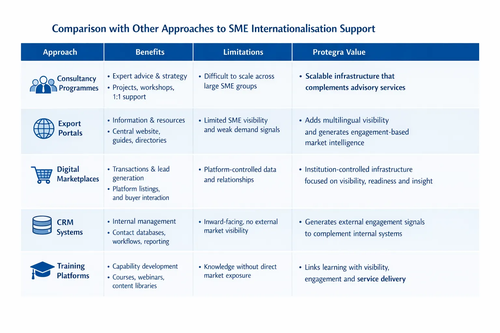
Consultancy-Led Support Programmes
Consultancy provides tailored, expert support but is resource-intensive and difficult to scale.
MarketPilot complements this by enabling organisations to deliver structured, consistent support across large SME communities, while generating data that helps target advisory interventions more effectively.
Digital Marketplaces and B2B Platforms
Marketplaces facilitate commercial engagement and transactions between buyers and sellers.
They may support domestic markets, international markets, or both.
MarketPilot can incorporate marketplace capabilities within a broader framework that also includes visibility, knowledge resources, support services, business networks, and intelligence.
It can support marketplace participation but is not dependent upon any specific marketplace platform or operating model.
Export Promotion Portals and Information Hubs
Portals provide access to information, resources, and programmes, but typically operate as standalone destinations.
MarketPilot complements these resources by connecting information, visibility, support services, engagement activities, and intelligence within a coordinated framework.
CRM and Internal Support Systems
CRM systems manage relationships and internal processes but do not generate international visibility or market signals.
MarketPilot provides an external, market-facing layer, generating external engagement data that can complement internal systems and inform decision-making.
Training and Knowledge Platforms
Training builds capability but does not create visibility or reveal where market interest is emerging.
MarketPilot combines knowledge with practical application, linking learning to visibility, engagement and access to services within a structured system.
A Coordinated Infrastructure Solution
MarketPilot is not designed to replace existing services. It provides the infrastructure that connects them — bringing visibility, support, engagement, and intelligence together. Protegra provides that infrastructure, integrating these capabilities within a coordinated framework.
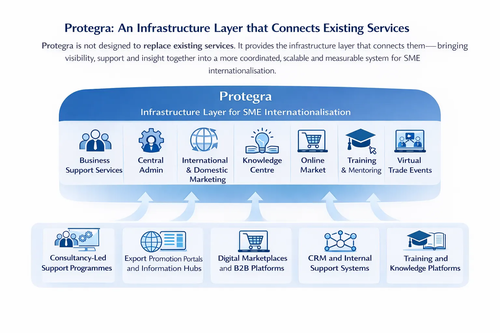
The Next Tab, Independent AI Assessment of MarketPilot, summarises how multiple independent AI platforms evaluated the MarketPilot model and the conclusions they reached.
Independent AI Assessment of MarketPilot
This section presents the findings of an independent evaluation of the MarketPilot model conducted using six leading AI platforms.
Each platform was provided with the same structured briefing and evaluation framework and asked to assess:
- conceptual soundness
- differentiation from existing approaches
- strengths and limitations
- practical applicability for institutions
The objective was to obtain an independent perspective on how MarketPilot compares with existing approaches to trade enablement and market development.
Methodology
Each AI platform received the same structured description of the MarketPilot model and the same evaluation questions.
Responses were generated independently and then reviewed to identify common themes, areas of alignment, and recurring implementation considerations.
The full briefing, questions, and responses are available in the accompanying downloadable document.
Cross-Platform Observations
The following observations summarise consistent themes identified across multiple independent AI platform assessments of the MarketPilot model.
While each platform applied different analytical approaches, there is a high degree of alignment in how the model is interpreted and evaluated.
Consistent Strengths
Across the assessments, MarketPilot is consistently recognised as:
- A structured framework linking data, intelligence, and execution
- Differentiated by its ability to convert intelligence into actionable trade outcomes
- Built on the integration of multiple data sources, including trade data, visibility signals, and payment flows where available
- Scalable for deployment across banks, chambers, and trade organisations
- Designed to address the “last mile” challenge in trade support — converting insight into coordinated action
Clear Differentiation
Across all assessments, MarketPilot is positioned as distinct from existing approaches:
- Beyond trade portals, which focus primarily on information access
- Beyond data platforms, which provide analysis without execution capability
- More scalable and repeatable than consultancy-led trade support
- More proactive and intelligence-driven than CRM-based export programmes
The model is consistently described as bridging the gap between trade data, institutional intelligence, and practical trade execution within a single coordinated framework.
Common Considerations
Across the assessments, several recurring implementation considerations are identified:
- Dependence on the availability, quality, and integration of multiple data sources
- Operational complexity in combining intelligence and execution workflows
- Institutional adoption challenges, including organisational structure and change management
- Variability in capability between institutions
- The need for clear governance, ownership, and measurable outcomes
Several platforms also highlight the importance of:
- Transparency in how intelligence is generated
- Measurable execution outcomes to support the continuous intelligence cycle
Overall Positioning
Across all evaluations, MarketPilot is consistently positioned as:
- A trade intelligence and execution framework rather than a standalone tool
- An institutional operating model integrating multiple capabilities into a coordinated process
- A bridge between trade data and practical trade enablement
- A system designed to support scalable, intelligence-led international trade development
Several platforms describe the model as functioning similarly to a “trade operating system” or institutional “trade enablement framework”.
Implementation Perspective
Across the assessments, MarketPilot is consistently viewed as a framework that can be implemented progressively.
Several platforms noted the importance of governance, institutional adoption, measurable outcomes, and the availability of appropriate data sources.
The assessments indicate that MarketPilot's effectiveness depends not only on the model itself, but also on the quality of implementation and institutional engagement.
Conclusion
Across multiple independent AI platforms, there is a high degree of consistency in how MarketPilot is interpreted.
Several platforms describe the model as functioning similarly to a "trade operating system" or institutional "trade enablement framework".
The model is consistently positioned as a structured framework linking intelligence, engagement, and execution within a coordinated institutional environment.
The assessments indicate that long-term effectiveness depends on implementation quality, governance, data integration, and institutional adoption.
The Next Tab, Partnerships, explains how organisations can begin exploring MarketPilot and assess its suitability for their objectives, services, and SME base.
Working Together
The diagram below illustrates how MarketPilot is designed to be implemented in partnership, integrating existing services within a coordinated framework.
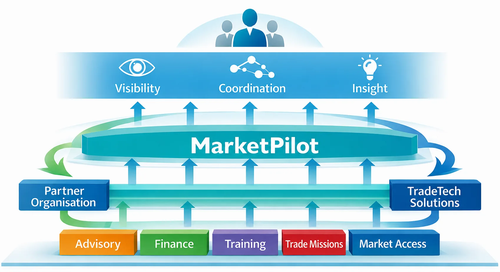
It complements and strengthens your existing services, adding the visibility, coordination and insight needed to support SMEs more effectively in domestic and international markets.
TradeTech Solutions works alongside partner organisations to structure, customise and deploy a MarketPilot solution aligned with their strategic objectives and the needs of their SME communities.
Why Partner?
Most partner organisations already support SME growth and market development. MarketPilot integrates, enhances and scales them within a coordinated digital framework.
In many cases, partner organisations already possess:
- An established SME, member or client community
- Existing services, programmes, or business networks
- Strategic objectives relating to growth, engagement, or market development
The partnership process therefore focuses on building on existing strengths and establishing the additional capabilities required to deliver a Digital Business Community
What a Partnership Offers
Partnership structures are flexible and can be aligned with the priorities of each organisation.
The first objective is to establish a coordinated Digital Business Community implementation programme that can be expanded progressively over time.
As SME activity grows, organisations gain greater opportunities to deliver additional value and support.
This creates opportunities to strengthen engagement, increase service utilisation, and expand the long-term value delivered to your SME community.
Common questions regarding implementation and data are addressed in the MarketPilot FAQs.
Starting the Conversation
If your organisation has an established SME, member, or client base that could benefit from MarketPilot, we invite you to begin a strategic discussion.
This is not a commitment to deploy, but an opportunity to explore:
- Institutional objectives
- Capability gaps
- Potential partnership models
- Phased implementation options
To arrange an exploratory discussion, please contact TradeTech Solutions.
This is not a commitment to deploy, but an opportunity to explore:
- Institutional objectives
- Capability gaps
- Potential partnership models
- Phased implementation options
To arrange an exploratory discussion, please contact TradeTech Solutions.