Protegra – Overview
PROsperity through Technology-Enabled Growth, Reach and Access
If your organisation supports SMEs—whether as members, clients, customers, or partners—and part of your mission is to support business growth and market development, Protegra is directly relevant to you.
Supporting SME growth and market development presents a significant challenge. Protegra has been developed to help address this.
The Challenge – Unlocking the potential of your SME base
Organisations already provide valuable services—finance, training, advisory support, networks and market access. These services often exist across multiple providers, platforms, and programmes.
For SMEs, identifying the right information, resources, services, and opportunities can be difficult.
The challenge is to increase participation, engagement, and business growth among SMEs.
Many SMEs perceive growth initiatives, digital transformation, market development, and exporting as complex and risky. To engage them, organisations must present real opportunities alongside the support needed to convert and deliver them.
This creates a dual requirement: (1) identify credible opportunities and (2) coordinate the resources, services, and support needed to realise them.
Most SMEs already have growth potential. What they often lack is visibility, structure, and coordination.
The Solution
Protegra addresses this by providing a connected infrastructure that complements existing services.
It brings together everything needed to support business growth and market development within a coordinated framework.
The Next Tab, The Protegra Solution, summarises ......
The Protegra Solution
Protegra is a Trade Enablement Infrastructure. It provides coordinated access to the wide range of services and resources needed by SMEs. It replaces fragmented support with a single, structured framework.
Core Components of the Protegra Infrastructure
Protegra brings together the essential elements within a coordinated framework:
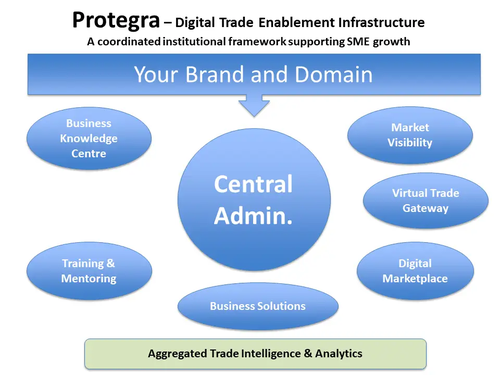
Institutional Coordination
- Central Administration Hub
Platform governance, coordination and operational management
Knowledge & Capability
- Business Knowledge Centre
Structured trade knowledge and decision-support resources - Training and Mentoring
Export capability development and practical guidance
Market Access & Engagement
- Market Visibility
International discoverability across languages and markets - Virtual Trade Gateway
Structured digital access to international market opportunities
Business Support & Commercial Engagement
- Business Solutions
Access to trusted specialist providers supporting trade operations - Digital Marketplace
Structured commercial engagement and partnership development
The value of Protegra lies in how these components are integrated into a coordinated system.
Addressing the Six Structural Trade Functions
To arrange an exploratory discussion, please contact TradeTech Solutions.
The Protegra section concludes with Inside Protegra, which provides additional detail on the operational components and capabilities that can be incorporated within a Trade Enablement Infrastructure.
These are embedded within the infrastructure, removing the need for SMEs to coordinate them independently:
- Buyer–supplier connectivity — structured introductions and matching
- Cross-border communication — multilingual engagement channels
- Risk management — coordinated advisory and support
- Logistics and supply chains — integration of trusted partners
- Finance and pricing — aligned financial and commercial frameworks
- Documentation and digital processes — streamlined compliance and digitalisation
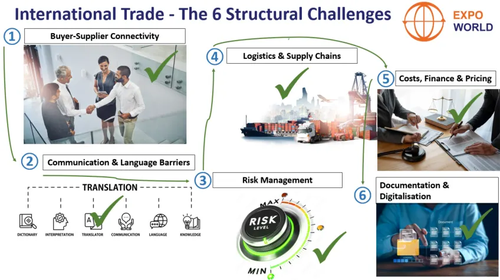
Protegra integrates these elements within a single coordinated framework.
The Next Tab, Strategic Value, outlines the institutional outcomes and benefits of deploying a Trade Enablement Infrastructure, including enhanced engagement, scalable service delivery and data-driven market insight.
Strategic Value
Protegra enables organisations to move from fragmented service delivery to coordinated, data-driven support for SME growth, market development, and internationalisation.
By establishing a structured Trade Enablement Infrastructure, institutions can strengthen both the reach and effectiveness of SME support.
Key outcomes include:
Strengthened Engagement with the SME Community
Continuous visibility and engagement create ongoing interaction between SMEs, markets, and support organisations, increasing engagement beyond one-off programmes or events.
Expanded Service Delivery Without Increasing Complexity
Digital infrastructure enables institutions to scale support across their SME base without proportionally increasing internal resources or operational burden.
Generation of Actionable Market Intelligence
Aggregated engagement data provides insights into demand, interest and market trends, supporting evidence-based decision-making.
More Targeted and Effective Support Programmes
Institutions can align training, advisory services, trade missions and partner support with actual market signals rather than assumptions or historical data.
Measurable Economic Impact
By linking visibility, engagement, and support services, organisations can more clearly demonstrate outcomes in terms of SME growth, market development, and trade activity.
Strategic Positioning as a Digital Trade Enabler
Deploying a Trade Enablement Infrastructure positions the organisation as a central, data-driven facilitator of business growth, market development, and international trade rather than a provider of isolated services.
The Next Tab, Operational Model, explains how the framework operates in practice, outlining how its components function together as an integrated system to deliver coordinated support and generate trade intelligence.
Operational Model
The Protegra Trade Enablement Infrastructure operates as a coordinated system connecting SMEs with international markets, partners, and specialist support services.
Protegra is deployed as a partner-owned platform, tailored to each organisation and implemented under its own domain.
It is supported by enabling infrastructure and services provided through ExpoWorld, including:
- Multilingual Microsites — providing structured international visibility and generating measurable engagement data
- Business Knowledge Centre — providing structured knowledge, practical guidance and access to curated trade resources
These elements combine with institutional services, tools and data to form a coordinated Trade Enablement Infrastructure.
The relationship between these elements is illustrated below.
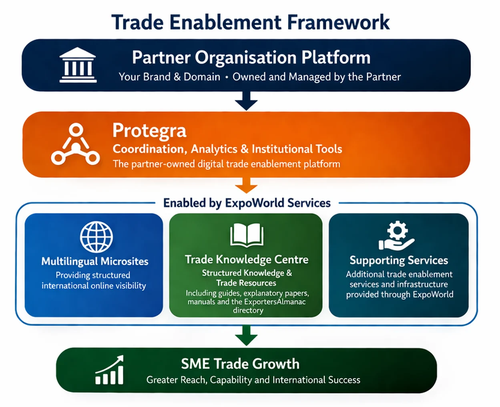
This framework shows how visibility, support functions and data interact within an integrated system.
Operational Components
The infrastructure operates through several complementary operational components:
Market Visibility
Participating SMEs gain a structured multilingual digital presence, enabling international buyers, partners and investors to discover their capabilities across multiple markets.
While each Multilingual Microsite strengthens the visibility of the individual company, the Protegra infrastructure also creates an aggregated discovery layer that significantly expands overall reach.
Aggregated Company Discovery
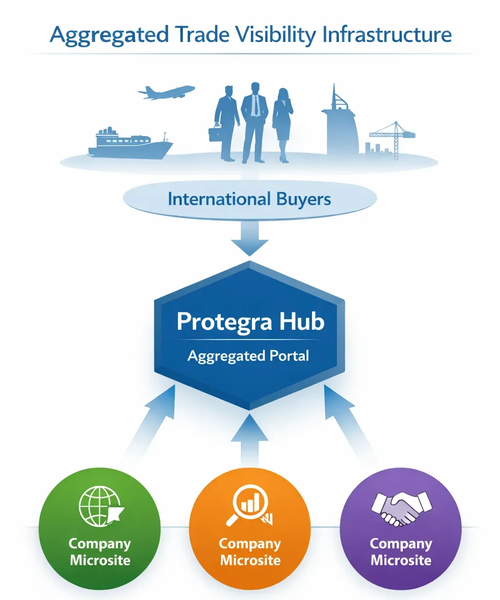
Each SME is represented through its own Multilingual Microsite, while the aggregated portal provides a central discovery gateway.
This structure enables international users to explore participating companies by sector, product category or country.
As participation increases, the aggregated portal expands as a structured international discovery layer.
Aggregated Trade Intelligence
As international users engage with company content, measurable interaction data is generated.
This data is aggregated and analysed to identify patterns across:
- countries
- sectors
- product categories
Export Capability Development
Training resources, knowledge frameworks and practical trade guides support SMEs in strengthening export readiness and navigating international trade processes.
Collaboration and Community Infrastructure
Structured engagement tools enable SMEs, institutions and partners to interact, exchange opportunities and build trade relationships within a coordinated environment.
Institutional Intelligence Dashboards
Participating institutions access aggregated insights that support programme design, prioritisation and resource allocation.
From Digital Visibility to Trade Outcomes
Together, these operational layers define how the infrastructure functions as a connected system.
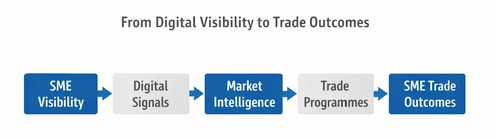
International discovery and engagement generate structured data, which is transformed into actionable trade intelligence. These insights are generated from distributed company-level visibility, while maintaining full data ownership at the individual company level.
For further details on data ownership, GDPR compliance and analytics, please refer to the Protegra FAQs.
The Next Tab, Illustrative Trade Intelligence, presents examples of the types of trade intelligence generated by the Protegra framework. It shows how international visibility and engagement translate into actionable insights on demand, activity and market trends.
Illustrative Trade Intelligence
The following examples use illustrative data to demonstrate the types of analytical insights generated by the Protegra Trade Enablement Infrastructure.
From Visibility to Insight
Most digital solutions focus on tools or promotion.
Protegra goes further.
By creating market visibility for SMEs and capturing the resulting engagement, the platform generates aggregated trade intelligence—structured insights into:
- Which countries are showing interest
- Which sectors and products are attracting attention
- How engagement evolves over time
This enables organisations to move from assumption-based support to evidence-based trade enablement.
The following examples use illustrative data to demonstrate the types of analytical insights generated by the Trade Enablement Infrastructure.
The diagram below shows how digital activity is transformed into actionable trade intelligence.
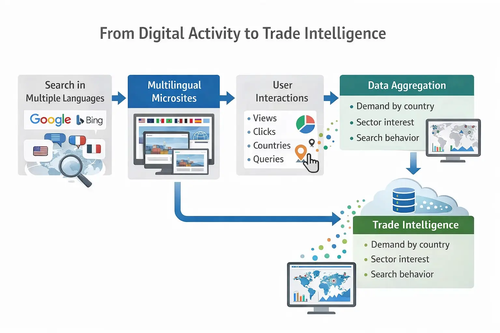
These analytics do not simply report digital activity. They convert international visibility signals into actionable trade intelligence.
In effect, the infrastructure functions as a continuous global market-sensing system for the SME community.
While the examples below present high-level summaries, in practice the underlying data can be analysed at significantly greater granularity and exported in structured formats (such as CSV) for integration with institutional systems.
Data and visibility infrastructure can reveal international demand patterns and emerging opportunities. However, institutions remain responsible for designing and implementing the programmes that convert these opportunities into tangible trade outcomes for their SME communities.
1. International Demand Signals Over Time
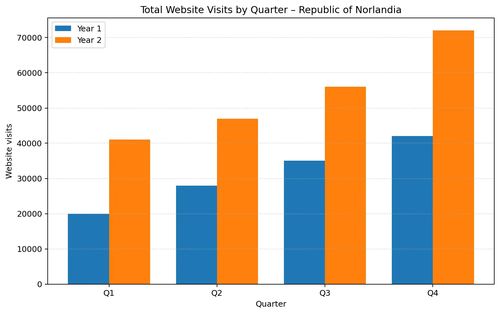
The first analytical layer tracks total international engagement across the Trade Enablement Infrastructure.
This provides insight into:
- Seasonal patterns in international interest
- Growth or decline in demand signals over time
- The impact of trade missions or promotional campaigns
- Periods of accelerated international engagement
This represents the macro-level demand signal generated across the SME community.
2. Geographic Market Intelligence
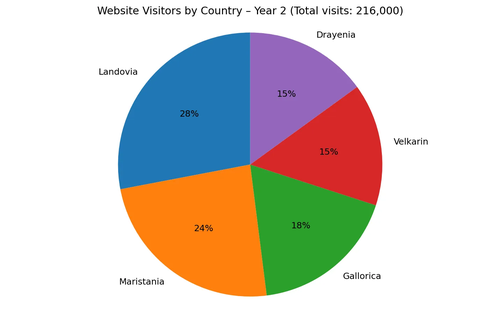
Understanding where international interest originates is critical for designing effective export programmes.
This analysis highlights:
- Countries generating the strongest engagement
- Emerging geographic markets
- Market concentration risks
- Alignment (or misalignment) with institutional export priorities
Institutions can therefore prioritise markets based on measurable demand signals rather than assumptions.
3. Sector-Level Market Intelligence
(NACE Classification)
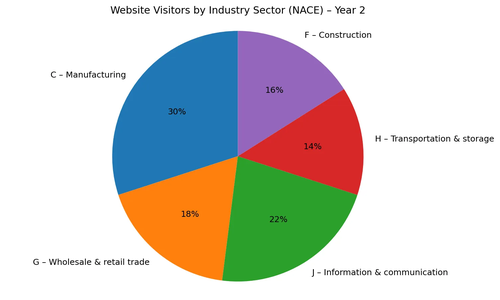
International engagement can be analysed at the sectoral level using structured industry classifications such as NACE.
This enables institutions to support:
- Sector prioritisation strategies
- Cluster development initiatives
- Targeted trade delegations
- Evidence-based allocation of support resources
Sector analysis can be viewed in aggregate or segmented by country.
4. Product-Level Market Intelligence
(Harmonised System - HS Classification)
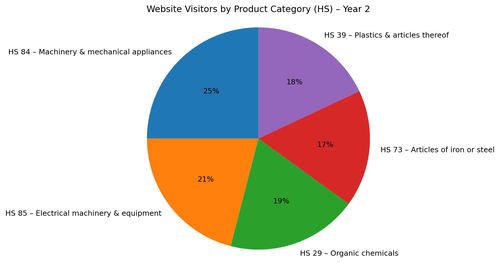
International demand can also be analysed at the product level using the internationally recognised Harmonised System (HS) classification.
This supports:
- Product-specific export readiness programmes
- Identification of high-potential product categories
- Alignment with tariff and regulatory frameworks
- Market-entry preparation by product type
As with sector analysis, product demand can be examined globally or at individual country level.
5. Linking Market Intelligence to Participating SMEs
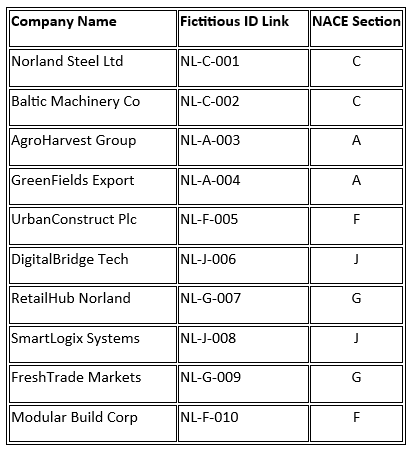
The next step is to put this intelligence into action.
Aggregated demand signals can be cross-referenced with companies participating in the Trade Enablement Infrastructure, without compromising privacy.
Companies already publish structured information including:
- Industry classifications
- Product categories
- Core business capabilities
The system links demand signals to all relevant companies within these categories without exposing individual traffic data.
This preserves anonymity while enabling structured institutional engagement.
The resulting internal reference ID can connect directly to:
- The organisation’s CRM system
- The company’s Multilingual Microsite
- Internal export advisory workflows
6. Mapping Product Demand to Participating Companies
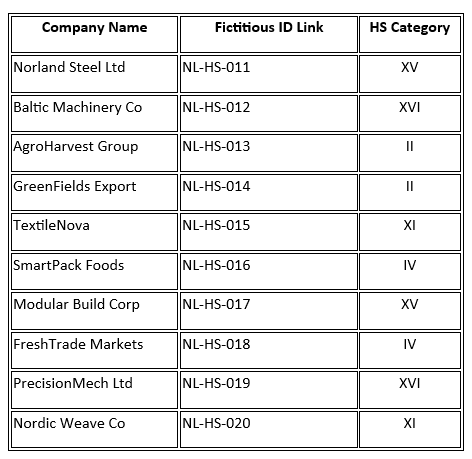
The same methodology can be applied at the product level.
Institutions can identify which companies operate within high-interest product categories and design targeted initiatives such as:
- Advisory outreach programmes
- Export readiness workshops
- Buyer introduction programmes
- Trade mission invitations
This is where analytics becomes operational action.
Strategic Implications
The Trade Enablement Infrastructure therefore functions not merely as a reporting tool, but as a decision-support system for institutions responsible for export development.
It supports:
- Export programme design
- Trade mission targeting
- Cluster development initiatives
- Financial support allocation
- Policy engagement and economic development planning
Most importantly, this intelligence is derived from real market engagement and digital activity, creating a continuous demand signal from global markets.
These illustrative insights demonstrate how aggregated digital activity can be transformed into actionable trade intelligence. The examples shown are based on aggregated and anonymised data, and Protegra does not rely on the processing of personal data for its core functionality.
Further details on data protection and GDPR compliance are available in the Protegra FAQs.
The Next Tab, Implementation Framework, explains how a Protegra solution can be implemented in practice. It outlines the framework used to deploy and scale the solution in a structured and manageable way.
Implementation Framework
Protegra is implemented through a structured framework that enables organisations to deploy and scale a Trade Enablement Infrastructure in phases with minimal disruption.
A practical and accessible approach
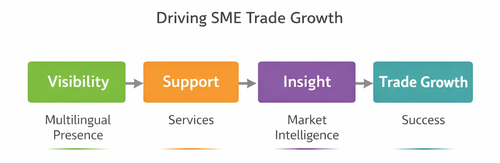
In practical terms, this means your organisation can support SMEs not only with services, but also with visibility, engagement, and measurable market feedback.
Protegra is designed to be:
- Quick to implement
- Low complexity
- Modular and scalable
It does not require significant investment in new technology or internal development. Organisations can begin with a focused initial phase and expand progressively over time.
Implementation typically begins with a review of the services and programmes already provided by the organisation. Protegra is designed to integrate with existing initiatives — including training programmes, export advisory services, trade missions and partner networks — strengthening and extending their impact rather than replacing them.
Deployment normally begins with the establishment of the Trade Enablement Infrastructure, enabling participating SMEs to establish multilingual international visibility while simultaneously generating aggregated market intelligence.
The framework below illustrates how Protegra can be implemented progressively, with each stage building on the previous one.
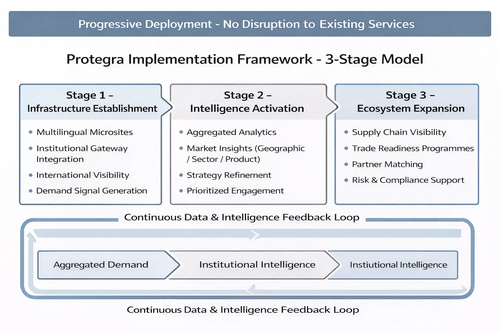
These three stages are outlined below.
Stage 1 – Infrastructure Establishment
(Creating the multilingual visibility and data foundation.)
Participating SMEs are provided with Multilingual Microsites and integrated into the institutional gateway.
This immediately:
- Establishes international visibility
- Establishes structured digital presence
- Begins generating aggregated demand signals
This stage creates the foundational visibility and intelligence infrastructure for the entire system.
Stage 2 – Intelligence Activation
(Generating market insights and demand signals.)
Aggregated analytics begin to reveal:
- Geographic demand patterns
- Sector-level engagement
- Product-level interest
Institutions can use these insights to:
- Refine export promotion strategies
- Prioritise international engagement
- Align programmes with measurable demand
This stage transforms visibility into actionable trade intelligence.
Stage 3 – Infrastructure Expansion
(Extending services, collaboration and institutional capabilities.)
Once the foundation is established, additional Protegra modules can be progressively deployed, including:
- Supply-chain visibility tools
- Trade readiness programmes
- Partner matching tools
- Risk and compliance support services
This stage enables institutions to build a fully integrated Trade Enablement Infrastructure around validated demand signals.
Implementation Logic
This phased approach enables institutions to begin with a practical operational layer while progressively expanding capabilities over time.
It reduces complexity, limits upfront resource requirements and ensures that each stage is informed by real market intelligence rather than assumptions.
Enabling Delivery at Scale
Advances in AI, SaaS architecture and digital platforms make it possible to deliver coordinated support efficiently and at scale.
Protegra enables organisations to deliver this support in a structured and scalable way across their SME communities, anchored in international online presence and supported by aggregated data that reveals emerging demand and market opportunities.
Institutional Engagement and Ongoing Activity
The effectiveness of the Trade Enablement Infrastructure depends on active institutional engagement. This effectiveness increases over time as participation, content quality and engagement levels grow.
While Protegra provides the digital framework for international visibility, coordination and insight, its impact is maximised when organisations:
- Actively onboard and support participating SMEs
- Encourage regular content updates and structured company information
- Integrate the platform into existing programmes and outreach activities
In this context, Protegra should be understood as an enabling infrastructure that supports and amplifies institutional activity, rather than replacing it.
Further details on implementation models, resource requirements and platform development are available in the Protegra FAQs.
Institutions seeking to strengthen SME growth, market development, and internationalisation through coordinated infrastructure are invited to explore potential collaboration with TradeTech Solutions.
The Protegra section concludes with Inside Protegra, which provides additional detail on the operational components and capabilities that can be incorporated within a Trade Enablement Infrastructure.