Inside Protegra
Protegra is a configurable business-growth and market-development framework.
It can be adapted to the objectives, priorities, and requirements of different Sponsor Organisations.
The following sections introduce the principal components of a typical Protegra implementation.
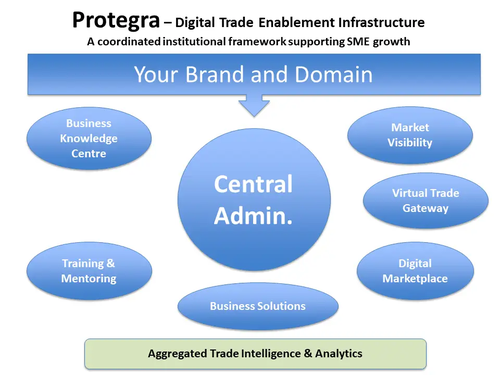
Important Note: The Protegra framework is intended to illustrate how a coordinated trade-enablement infrastructure can be structured and implemented.
While the framework presents an integrated model, many of the resources and services referenced are available independently and can provide practical support immediately.
Visitors are therefore encouraged to view Protegra both as an illustrative framework and as a source of practical resources that can assist current trade-development and internationalisation activities.
Protegra does not operate as a single service.
It combines complementary capabilities that can be configured according to the objectives and requirements of the Sponsor Organisation.
Different Protegra implementations may include different combinations of services, partners, resources, and delivery models.
Existing capabilities can be retained, integrated, and expanded where appropriate.
The Next Tab, Integrated Framework, explains how the principal components of Protegra are designed to work together.
An Integrated Framework
Although the Protegra framework is presented as seven distinct components, these elements are designed to operate as an integrated system.
Information, resources, training, events, services, market visibility, and commercial engagement should support one another.
The objective is to make it easier for businesses to identify, understand, and implement solutions to practical business challenges.
Illustrative Examples
The examples provided throughout this section are intended for illustrative purposes only.
Some examples are drawn from existing UK-based resources and services.
Equivalent capabilities may be provided by different organisations in other countries.
Protegra does not require any specific services, providers, resources, or organisational structures.
The Next Tab, Central Administration, introduces the operational coordination hub at the centre of a typical Protegra implementation.
Central Administration
The Central Administration function provides operational coordination across the Protegra framework.
It helps manage communications, engagement activities, programme administration, and community participation.
Operational Coordination
Central Administration supports the day-to-day operation of the Protegra framework.
Examples may include:
- subscriptions and registrations;
- helpdesk and support services;
- programme administration;
- user management; and
- operational coordination.
Communications and Engagement
Effective communication is essential to maintaining an active and engaged business community.
Central Administration helps coordinate communications between the Sponsor Organisation and participating businesses.
Structured newsletters can help keep members informed about resources, events, opportunities, services, and relevant developments.
Events and Community Activities
Webinars, workshops, briefings, and other online events help maintain engagement and support the ongoing development of the Protegra community.
These activities may be coordinated through the Central Administration function, even where separate event platforms are utilised.
Technology and Platform Selection
A range of third-party solutions are available to support administration, communications, newsletters, events, and community engagement. (See Team Collaboration Platforms listed in the ExportersAlmanac, for example.)
Where suitable solutions are not already in place, one of the first implementation steps is identifying the required capabilities.
Suitable technologies and service providers can then be selected.
Knowledge Capture
Newsletters, webinars, reports, presentations, and other materials can provide long-term value.
Where appropriate, these resources can be organised and made available through the Knowledge Centre to support future research, learning, and business development.
The Next Tab, Business Knowledge Centre, explains how information, resources, reference materials, and other knowledge assets can be organised and made accessible to the Protegra community.
Business Knowledge Centre
The Business Knowledge Centre provides access to information, guidance, reference resources, research materials, and practical business-support content.
Its purpose is to help businesses identify, understand, and implement solutions to practical business challenges.
Information and Resource Management
Businesses often need access to information from multiple sources.
The Business Knowledge Centre helps organise resources so they are easier to discover, access, and utilise.
Examples include:
- articles and guides;
- newsletters and briefings;
- webinars and recorded events;
- reports and research materials;
- reference resources; and
- business-support information.
Editorial Organisation
The value of a Knowledge Centre is determined not only by the quality of its content, but also by how that content is organised.
Resources can be structured around business challenges, use cases, sectors, technologies, markets, or other Sponsor-defined priorities.
Learning and Implementation
The Business Knowledge Centre is designed to support other Protegra components.
Resources may support training programmes, mentoring activities, events, business services, and market-development initiatives.
Illustrative Examples
Examples of resources that may support a Business Knowledge Centre include:
These examples are provided for illustrative purposes only and demonstrate the types of resources that may support a Protegra implementation.
The Next Tab, Training & Mentoring, explains how knowledge, guidance, and resources can be translated into practical skills, capability development, and business support.
Training & Mentoring
Access to information is important.
However, implementing change often requires new skills, knowledge, and practical experience.
Training and Capability Development
Training programmes can help businesses develop the capabilities required to support growth, digitalisation, market development, and internationalisation.
Where appropriate, training can be delivered online, making it easier for businesses to access learning resources regardless of location.
Examples may include:
- online courses;
- workshops and webinars;
- professional development programmes;
- certification programmes; and
- sector-specific training initiatives.
Further examples can be seen: ExpoUK.cloud's Training Section.
Mentoring and Practical Support
In some situations, businesses may benefit from additional guidance and practical support.
Mentoring programmes can help businesses understand options, evaluate alternatives, and implement appropriate solutions.
Examples may include:
- one-to-one mentoring;
- sector specialists;
- business advisers;
- peer-learning programmes; and
- structured mentoring initiatives.
One example of an organisation specialising in providing mentoring services is DHL GoTrade
Integrated Learning and Support
Training and mentoring are most effective when supported by relevant information, resources, and follow-up guidance.
Learning materials can be supported by Knowledge Centre resources, recorded webinars, reference materials, practical guides, and other supporting content.
Illustrative Examples
- online training providers;
- sponsor-developed learning programmes;
- professional development organisations; and
- sector-specific training providers.
Examples of online training providers can be found within the Training section of ExpoUK indicated above.
N.B. These examples are provided for illustrative purposes only.
Different Protegra implementations may utilise different training providers, mentoring programmes, and delivery models.
The Next Tab, Market Visibility, explains how businesses can improve discoverability and market visibility across domestic and international markets.
Market Visibility
Visibility is often the first step towards engagement.
Before businesses can attract customers, partners, investors, suppliers, or other stakeholders, they first need to be discoverable.
Self-Help
Many businesses can improve visibility by taking practical steps to review and strengthen their existing online presence.
Examples may include:
- reviewing current online visibility;
- improving company information and profiles;
- strengthening website content;
- improving search visibility; and
- increasing market-specific visibility.
Examples of practical first steps can be found in the Your Company Profile section of ExpoUK
Microsites and Multilingual Microsites
Businesses seeking to improve visibility may also benefit from dedicated Microsites or Multilingual Microsites.
For businesses interested in international markets, Multilingual Microsites can help improve discoverability across multiple countries and languages.
For businesses focused primarily on domestic markets, Microsites can provide an additional online presence and improve visibility within Sponsor-supported directories and initiatives; as suggested here.
Protegra Sponsor Support
Sponsor Organisations can also help improve the visibility of participating businesses.
Examples may include:
- member directories;
- business directories;
- sector directories;
- promotional activities;
- virtual trade events; and
- trade missions.
By creating and promoting accessible online directories, Sponsor Organisations can help improve the visibility of participating businesses and strengthen market engagement.
Business Profiles and Digital Identity
Business profiles can serve purposes beyond visibility and promotion.
Structured company profiles can provide a reusable source of business information.
The same information can be used to support onboarding, supplier qualification, customer due diligence, KYC, AML, and other business processes.
Information can be maintained in a single location and made available to third parties as required.
This helps reduce duplication, improve consistency, and simplify participation across different Protegra services and activities.
An Integrated Approach
Market Visibility does not operate in isolation.
Visibility initiatives can support Virtual Trade Gateways, trade missions, business events, Digital Marketplaces, and other Protegra activities.
The most effective approaches typically combine business-led actions with Sponsor-supported initiatives.
The Next Tab, Virtual Trade Gateway, explains how increased visibility can be translated into engagement, market access, and business-development opportunities.
Virtual Trade Gateway
The next step is creating meaningful engagement with potential customers, partners, suppliers, and other stakeholders.
The Virtual Trade Gateway helps convert visibility into engagement, communication, collaboration, and commercial interaction.
Business Engagement
The Virtual Trade Gateway can provide structured pathways for businesses to engage with potential customers, partners, suppliers, investors, and other stakeholders.
Examples can include:
- virtual trade events;
- trade missions;
- business-matching activities;
- partner introductions;
- trade briefings; and
- sector-focused events.
Commercial Platforms
A range of third-party platforms can support commercial engagement and business collaboration.
Examples include:
- opportunity platforms;
- procurement platforms;
- contracting platforms;
- project platforms; and
- collaboration platforms.
Trade and Project Management
Additional tools may support the management of commercial relationships and ongoing activities.
Examples include:
- contract management;
- contract tracking;
- project tracking;
- collaboration tools; and
- workflow management systems.
An Integrated Approach
The Virtual Trade Gateway works closely with other Protegra components.
- Market Visibility can help businesses become discoverable.
- The Virtual Trade Gateway can help initiate engagement and communication.
- Business Services and Digital Marketplaces can then support the practical implementation of commercial opportunities.
Illustrative Examples
Different Protegra implementations may utilise different event platforms, collaboration tools, contracting systems, procurement platforms, and trade-engagement solutions.
The most appropriate combination will depend on the objectives and requirements of the Sponsor Organisation.
The Next Tab, Business Solutions, explains how specialist support services can help businesses implement and support commercial activities.
Businesses often face practical challenges that require specialist support.
- In some situations, businesses already know the type of provider they require. See: ExpoUK's Support Services Section and the ExportersAlmanac's Support Services for some examples.
- In other situations, businesses understand the challenge they face but not the most appropriate solution. See ExpoUK's Business Solutions for examples of how these can be presented.
The Business Solutions component helps businesses identify relevant options, resources, services, and providers.
Problem-Solving Approach
Business Solutions are designed to help businesses identify practical options for addressing specific business challenges.
Examples include:
- Advertising & Marketing
- Back Office Support;
- Competitor Analysis
- Finance & Payments;
- International Logistics
- New Markets
- New Suppliers;
- Recruiting Staff; and
- Risk Reduction
Solution Categories
Depending on the challenge, businesses may require support from different specialists and service providers.
Examples include:
- finance and funding;
- payments;
- logistics;
- customs and compliance;
- legal services;
- insurance;
- translation services;
- marketing services; and
- technology providers.
See The ExportersAlmanac: Support Services, eCommerce and MarketSearch sections.
Guidance and Support
Business Solutions work closely with the Business Knowledge Centre, Training & Mentoring, and other Protegra components.
Businesses can access guidance, learning resources, implementation support, and potential solution providers through a coordinated framework.
Illustrative Examples
Examples of solution-oriented resources can be found within the various sections of ExpoUK.cloud.
Different Sponsor Organisations may utilise different service providers, partners, resources, and delivery models.
The objective is to make relevant solutions easier to identify, understand, and implement.
The Next Tab, Digital Marketplace, explains how businesses, buyers, suppliers, and service providers can engage within a structured commercial environment.
Digital Marketplace
The Digital Marketplace provides a structured environment for commercial interaction.
It can help businesses identify opportunities, suppliers, customers, partners, service providers, and other organisations relevant to their objectives.
A Progressive Development
The Digital Marketplace is often introduced after other Protegra components have been established. The Digital Marketplace is often one of the later components to be introduced within a Protegra implementation.
Knowledge resources, training, visibility initiatives, engagement activities, and business solutions can all help prepare businesses for effective marketplace participation.
Commercial Interaction
Examples include:
- buyer and supplier discovery;
- opportunity sharing;
- tender opportunities;
- project opportunities;
- service-provider listings;
- partner identification; and
- commercial collaboration.
Flexible Approaches
Different Sponsor Organisations may adopt different marketplace models.
Examples include:
- business directories;
- opportunity platforms;
- procurement platforms;
- sector marketplaces;
- partner-matching platforms; and
- commercial networking platforms
An Integrated Environment
The Digital Marketplace works alongside other Protegra components.
- Market Visibility can help businesses become discoverable.
- Virtual Trade Gateway activities can support engagement and introductions.
- Business Solutions can help businesses identify and implement appropriate solutions.
Together, these components can help create a more effective environment for commercial interaction and business development.
Illustrative Examples
Different Protegra implementations may utilise different marketplace solutions.
The most appropriate approach will depend on the objectives and requirements of the Sponsor Organisation.
The Next Tab, Key Considerations, summarises some of the principal implementation principles that may be relevant when designing and developing a Protegra framework.
Key Considerations
The seven Protegra components illustrate a typical framework structure.
- Different implementations may utilise different combinations of services, resources, partners, and delivery models.
- Protegra is designed to be modular, adaptable, and implemented in phases.
- Existing capabilities can be retained, integrated, and expanded where appropriate.
- The objective is not to replace existing resources and services.
- The objective is to make them easier to identify, access, coordinate, and utilise.
- The value of Protegra does not arise from the individual components alone.
- It arises from the integration and coordination of those components within a single framework.
- Successful implementations typically focus on practical business challenges and solutions rather than technologies alone.
If you would like to discuss how Protegra could support your organisation, please contact us at Protegra@tradetech.cloud