Overview
ATIM (Aggregated Trade Intelligence & Analytics) is the Trade Intelligence framework within the MarketPilot Solution.
ATIM supports analysis across 228 countries and territories and 97 HS2 product sectors and associated industry classifications through a consistent international trade-intelligence framework.
It aggregates and analyses multiple data sources to transform distributed information into actionable trade intelligence, enabling organisations to identify:
- market demand patterns;
- priority markets;
- trade corridors;
- sector opportunities; and
- trade-development priorities.
ATIM does not operate as a standalone system. It forms part of a coordinated MarketPilot solution that integrates:
- Online Visibility and Market-Interest Signals (Microsites and Multilingual Microsites);
- Global Trade Data (including Comtrade, ITC, and other international sources); and
- Payment Flow Intelligence (BICDetective)
ATIM intelligence can be delivered through a range of ATIM Trade Reports supporting market, sector, country, bilateral, trade-corridor, and trade-bloc analysis.
From Intelligence to Action
ATIM transforms integrated data into structured trade intelligence.
This intelligence can then be applied through ATIM Trade Reports, institutional analysis, and Protegra trade-development activities.
Applicability by Institution Type
ATIM is designed as a modular trade-intelligence capability that can be applied across banks, telecommunications providers, chambers of commerce, trade associations, and export-promotion organisations.
The Next Tab, How ATIM Works, explains how ATIM processes and transforms data into actionable trade intelligence.
How ATIM Works
ATIM operates through processes of data aggregation, harmonisation, enrichment, and analysis. These processes transform integrated data into structured trade intelligence and actionable insights.
Position within MarketPilot
ATIM operates as:
Data → Trade Intelligence →Trade-Development Execution
Where:
- Data is generated through international visibility signals, institutional data, and external sources.
- ATIM transforms data into structured trade intelligence.
- Protegra enables trade-development execution.
Integrated Trade Intelligence Model
ATIM aggregates, harmonises, enriches, and analyses multiple data sources to generate structured trade intelligence.
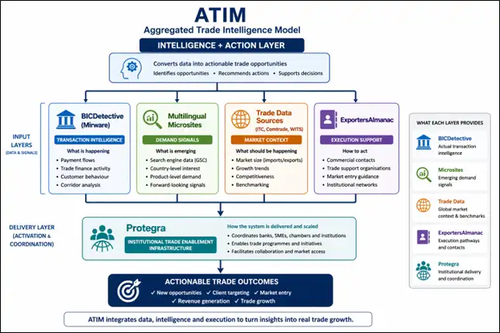
Visibility signals, global trade data, economic datasets, and payment intelligence are aggregated, harmonised, and integrated within a unified trade-intelligence solution.
Data Aggregation
Multiple data streams are combined:
- International trade data (including Comtrade, ITC, and other international sources)
- Payment flow data (bank-specific capability)
- International visibility signals
Data Structuring
Data is standardised and organised using:
- Sector classifications
- Product categories (e.g. HS codes)
- Geographic mapping
Analytical Processing
This stage identifies:
- Demand patterns
- Trade flows
- Comparative indicators
- Sector-specific trends
Intelligence Generation
This stage produces:
- Prioritised markets
- Analytical rankings
- Actionable insights
Intelligence outputs can be delivered through a range of ATIM Trade Reports supporting market, sector, country, bilateral, trade-corridor, and trade-bloc analysis.
From Intelligence to Action
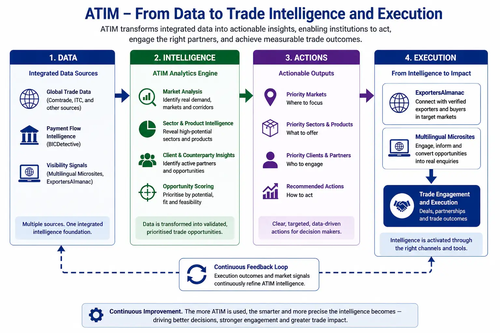
Trade intelligence supports practical decision-making, market prioritisation, and trade-development activities.
ATIM operates as a continuous intelligence cycle, ensuring that intelligence remains current, accurate, and responsive to changing market conditions.
The Next Tab, Data Sources, outlines the key data sources that support the ATIM model.
Integrated Data Sources
ATIM combines multiple categories of data to generate robust, multi-source trade intelligence.
It is designed to remain flexible and source-agnostic, allowing institutions to select and integrate data sources based on availability, cost, and analytical requirements.
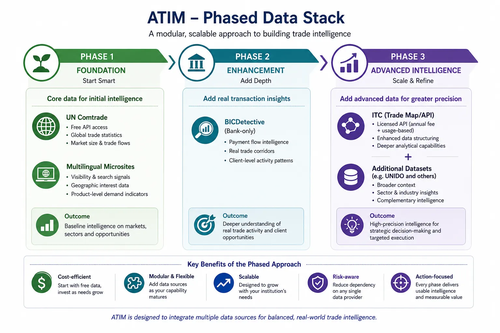
ATIM can be deployed progressively, starting with accessible data and scaling to more advanced intelligence capabilities.
Phased Approach: Start with accessible data (Comtrade and visibility signals), add transaction intelligence (BICDetective), and scale to advanced datasets as requirements evolve.
Global Trade Data
ATIM integrates data from a range of international sources, for example:
- UN Comtrade (API available – free access)
- International Trade Centre (API available – licensed access, usage-based)
- Additional institutional datasets (e.g. UNIDO and other international sources)
Provides:
- Global import/export statistics
- Market size indicators
- Product-level trade flows
Illustrative comparison of UN Comtrade and ITC data services.
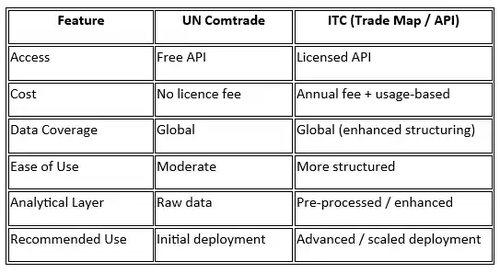
Important Note on Data Source Selection
ATIM is designed to combine multiple data sources, rather than relying on a single provider.
In initial deployments, UN Comtrade is typically recommended as a starting point due to:
- Open API access
- No licensing cost
- Sufficient coverage for early-stage analysis
ITC data can be introduced in later phases where:
- Enhanced data structuring is required
- Additional analytical depth is needed
- Budget and usage parameters are defined
Payment Intelligence (Banks only)
The example operational model shown below illustrates a bank implementation using BICDetective payment-flow intelligence. Equivalent ATIM deployments can also be configured using alternative institutional data sources.
Provides:
- Real transaction-level insights
- Actual trade corridors
- Client-level activity patterns
Online Visibility and Market-Interest Signals
- Microsites
- Multilingual Microsites
Microsites and Multilingual Microsites generate online visibility and market-interest signals, supported by analytics tools such as Google Search Console and Google Analytics.
Reference and Classification Resources
ExportersAlmanac
ExportersAlmanac integrates data from multiple reference sources, supporting:
- Country-level filtering
- Sector mapping
- Trade classification
- Structured trade context
Provides:
- Structured country and sector-level reference information
- Reference data for market analysis and filtering
- Support for sector mapping and trade classification
ATIM Reference Tools
- Code Mapping
- Classification Mapping
- Country Filtering
- Sector Mapping
Combined Value
By combining multiple data sources, ATIM produces more balanced, robust, and reliable intelligence outputs than can be achieved through a single source alone.
Different institutions may utilise different combinations of data sources depending on their objectives, available datasets, and operational role.
These combined data sources provide the inputs to ATIM, which transforms raw data into prioritised markets, analytical rankings, and actionable insights.
This model demonstrates how ATIM moves beyond analysis, ensuring that intelligence is systematically translated into execution.
The Next Tab, Outputs, explains how ATIM converts multi-source data into structured trade intelligence and analytical outputs.
Actionable Trade Intelligence
From Analysis to Actionable Outputs
The model below illustrates how ATIM converts structured analysis into market rankings, sector insights, client-targeting analysis, and actionable intelligence.
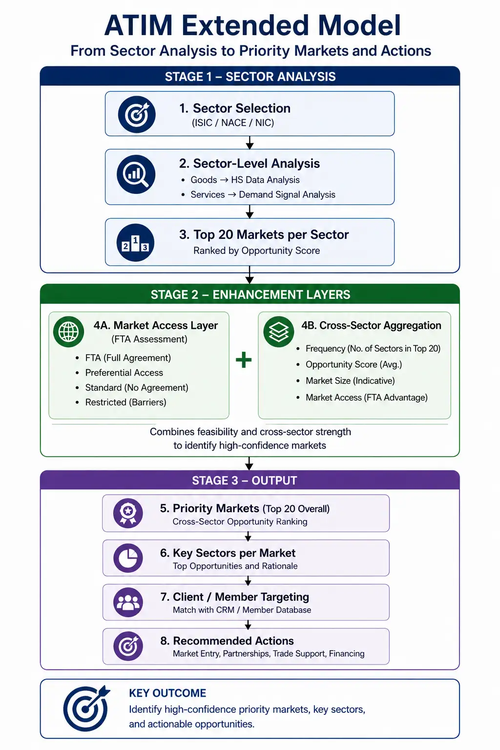
Core Outputs
1. Market Rankings
- Comparative ranking of countries and markets. Based on selected analytical criteria and benchmarks
2. Trade Corridor Analysis
- Mapping of active and emerging trade routes
- Identification of underdeveloped corridors
3. Sector Insights
- High-demand sectors
- Product- and service-level opportunity identification
4. Client / Member Analysis
(Only where institution-specific datasets are available)
- Identification of underutilised clients
- Cross-border activity insights
- Targeted engagement opportunities
From Analysis to Action
ATIM reports are designed to be:
- Clear
- Prioritised
- Directly usable
They enable institutions to prioritise opportunities and take informed action.
ATIM intelligence can be delivered through ATIM Trade Reports and institution-specific analytical outputs.
The Next Tab, Value, summarises the strategic and operational value of ATIM for institutions.
A Data-Driven Intelligence Capability
ATIM transforms data into a strategic asset, enabling institutions to operate with greater precision, clarity, and confidence.
ATIM operates as an ongoing process:
Data → Analysis → Insight → Refinement
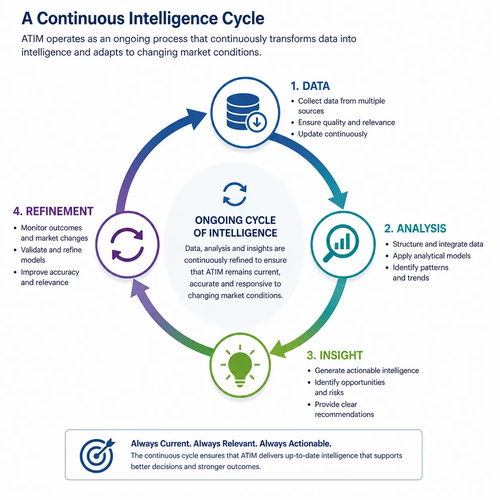
This cycle ensures that intelligence remains current, accurate, and responsive to changing market conditions.
In parallel, refined intelligence can be applied through Protegra and other trade-development activities to support practical execution.
Value for Telecommunications Providers
- Strengthen corporate client relationships
- Support SME growth and internationalisation
- Support digital capability development
- Support market-development initiatives
- Increase the value of business-service offerings
Value for Banks
- Visibility of real client trade activity
- Identification of revenue opportunities
- Optimisation of trade corridors
- Enhanced client segmentation
- Improved utilisation of FX, payments, and trade finance
Value for Chambers of Commerce and Trade Associations
- Evidence-based trade programme design
- Improved targeting of trade missions
- Enhanced SME support
- Better alignment with market demand
Value for Export-Promotion Organisations
- Support market-selection activities;
- Identify priority sectors and opportunities;
- Improve programme targeting;
- Strengthen trade-development planning; and
- Support more effective resource allocation.
Measurable Benefits
- Improved decision-making
- Targeted resource allocation
- Increased effectiveness of trade initiatives
- Demonstrable outcomes
Beyond Reporting
ATIM supports market discovery, trade intelligence, decision support, and trade-development planning.
Trade Reports represent one output of a broader intelligence capability.
Role within MarketPilot
ATIM forms the Trade Intelligence layer within MarketPilot, supporting market discovery, decision support, and trade-development activities through Protegra and other execution capabilities.
Next Step
Go to the MarketPilot page to see how intelligence is translated into market execution and measurable trade outcomes.