A practical framework for implementing Digital Business Communities
Transforming SME Relationships into Digital Business Communities
The MarketPilot Framework provides a structured approach to designing, launching and growing Digital Business Communities.
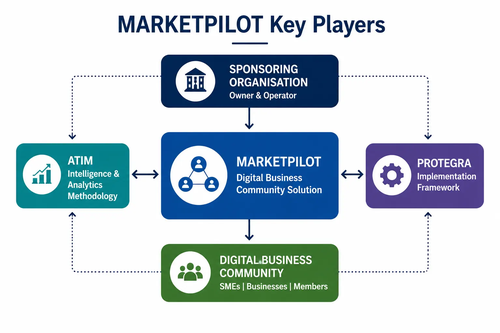
The MarketPilot Framework combines governance, implementation, digital capabilities and operational support to create and grow Digital Business Communities. It enables organisations to launch a Foundation Phase quickly while providing a clear roadmap for future expansion.
The Next Tab, Core Components, introduces the three complementary components that together make up the MarketPilot Framework.
Core Components
The MarketPilot Framework combines three complementary components:
- MarketPilot – provides the implementation methodology for creating and growing Digital Business Communities.
- ATIM – provides Trade Analytics & Community Intelligence to support planning and decision-making.
- Protegra – provides the digital capabilities, content and services used within the Digital Business Community.
Together, these components provide the coordinated capabilities needed to implement and operate Digital Business Communities.
The Next Tab, Deployment, explains how the MarketPilot Framework can be introduced progressively with minimal disruption to existing systems and services.
Modular Deployment
The MarketPilot Framework is designed for progressive deployment, enabling organisations to introduce new capabilities in line with their priorities and available resources.
Key Deployment Principles
1. Independent Modules
Each capability can be implemented independently.
2. Integration with Existing Systems
Integrates with existing systems and services.
3. No Replacement Requirement
Builds on existing investments rather than replacing them.
4. Progressive Scaling
Start with a Foundation Phase and expand over time.
5. Minimal Disruption
Strengthens and coordinates existing capabilities with minimal operational disruption.
The Next Tab, Foundation Phase, explains how organisations can launch a Digital Business Community quickly while establishing the foundations for future growth.
Foundation Phase
The Foundation Phase enables organisations to launch a Digital Business Community quickly while establishing the capabilities needed for long-term growth.
It delivers practical value from the outset while providing a structured platform for progressive expansion.
The Five Stages
1. Define Strategic Priorities
Identify the areas of greatest interest and relevance.
Examples may include:
- sectors;
- products;
- geographic markets;
- member or client segments; and
- institutional priorities.
2. Establish Trade Intelligence
Use ATIM to support analysis and decision-making.
Examples include:
- market selection;
- sector analysis;
- product analysis;
- trade corridor analysis; and
- opportunity identification.
3. Build Market Visibility
Establish a visible digital presence for participating organisations and begin generating market and community intelligence.
Examples include:
- distributing Microsites & Multilingual Microsites to members or clients;
- increasing market visibility;
- generating demand signals; and
- establishing a structured data foundation.
4. Connect Existing Services
Use Protegra to connect existing knowledge, services, programmes and business support into the Digital Business Community.
Examples include:
- knowledge resources;
- training programmes;
- visibility initiatives;
- engagement activities; and
- business-support services
5. Turn Intelligence into Action
Use trade and community intelligence to support practical engagement activities.
Examples include:
- member engagement;
- client activation;
- market-development initiatives;
- trade-development activities; and
- opportunity follow-up.
Optional Banking Module
Banks may also choose to incorporate payment-flow intelligence through BICDetective.
This can support:
- client intelligence;
- corridor analysis;
- opportunity identification; and
- portfolio segmentation.
Outcome of the Foundation Phase
- a functioning Digital Business Community;
- increased market visibility;
- stronger member or customer engagement;
- initial Trade Analytics & Community Intelligence; and
- a scalable foundation for future growth.
The Next Tab, Value, summarises the strategic and operational benefits that Digital Business Communities can deliver to banks, telecommunications providers, chambers of commerce and other business organisations.
Connecting Existing Services
Most organisations already provide valuable services, programmes and support to their SME community. The MarketPilot Framework builds on these existing capabilities rather than replacing them.
Protegra helps bring these services together so they work more effectively as part of a Digital Business Community.
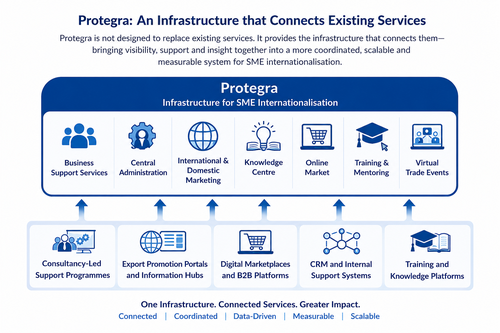
Further information about the Protegra Operating Framework is available in the Protegra section.